Use the filters to browse the information we have available or to narrow your search results for a specific audience (e.g. caregivers, military, children), a preferred type of content (e.g. videos, blogs, articles), or by topics of interest (e.g. family concerns, legal issues, symptoms).
“When I meet people, post-injury who may be stuck in a dark place, who may think their lives are destroyed, I say it’s going to be hard to picture the future but start by dipping your toes into the waters of adaptive sports in a group setting. The sooner you get involved, the better. You don’t have a clue what you will accomplish in life.”
While in the throes of dealing with symptoms from PTSD, my counselor suggested mindfulness and meditation, which I initially thought was a bunch of snake oil … something for hippies, monks, and weirdos. But then I started to learn about the science — and even a little history — and everything began to change; I literally started to breathe again.
The human brain is a three-pound organ that remains largely an enigma. But most people have heard of the brain’s gray matter, which is needed for cognitive functions such as learning, remembering and reasoning.
William "Bill" Jones joined the United States Army in response to the attacks on 9/11. After several deployments anger, anxiety, and symptoms of post-traumatic stress disorder (PTSD) were taking over and he retired from active duty.
Three of my four sons abruptly walked out of my life with no explanation and no communication. I was being ghosted long before that term even existed. It was, by far, the most painful part of my journey.
Ideally, trigger warnings allow individuals who have experienced trauma to be forewarned about material that may elicit unwanted memories of past traumatic events. However, some have hypothesized that trigger warnings have more costs than benefits, even for those with relevant traumas.
The brain is the organ that orchestrates all the diverse functions and complex decisions that take place in biological systems. Despite its critical nature, it is equally as fragile: the neurons that make up the brain do not regenerate like many other cell types.
I enjoy watching my husband cry. That sounds so much worse than what I really mean. He’s been on various medications for his PTSD some of which cause emotional blunting — not being able to laugh or cry when appropriate.
The National Military Family Association understands deeply that “military families serve, too,” alongside their service member or veteran parent or spouse.
Our Miiltary Kids recognizes children for being brave despite their parent’s deployment and all the challenges — large and small — that can come with a parent’s recovery from combat injuries.
To be human is to grieve, and everyone grieves differently and in their own time. But there is a type of grief that many people experience that is less common, less talked about, but none the less real and painful. It’s called ambiguous grief or ambiguous loss.
Adults who have suffered childhood trauma exhibit a higher degree of somatization (i.e., mental suffering expressed through physical complaints that may lead them to consulting a physician). A mother's trauma impacts the mother-child relationship.
Retired United States Army Sergeant Angela Peacock shares how a service dog, an RV, and Wounded Warrior Project helped heal her post-traumatic stress (PTSD).
State-level resources and supports have a small but significant impact on outcomes following serious TBI. Better Long-Term Services and Supports increase community participation and life satisfaction.
If you are anything like me, when you or your loved one are first given a diagnosis, you research. There is so much information available online, it can be overwhelming or frustrating to know which is accurate, but I find research helpful in being able to report or advocate to doctors for both myself and my loved ones.
A new study published in Neurology dispels the notion that "mild" concussions have no lasting impact on mental skills like thinking, remembering, and learning. Poor cognitive outcomes are common 1 year after injury.
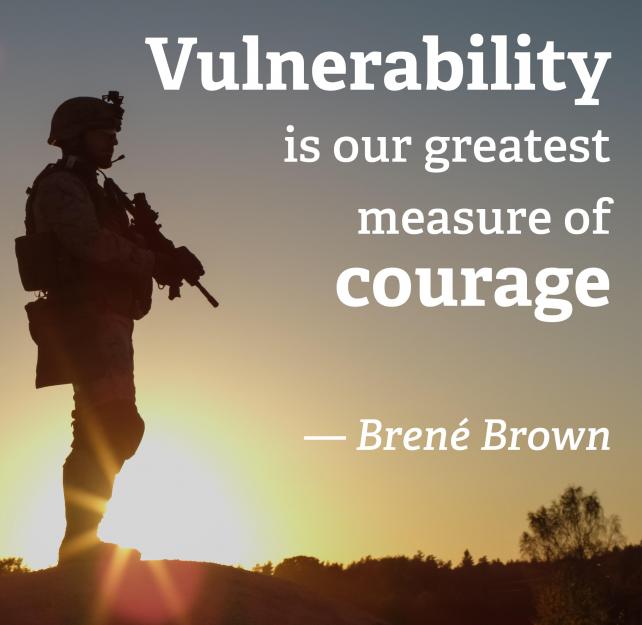
One lesson I have learned since I started meditating is the connection between courage and vulnerability. Yes, vulnerability. I know, it sounds like the antithesis of everything related to being a SEAL, but I have come to understand that while vulnerability and courage aren’t necessarily the same thing, it takes courage to show vulnerability and, in turn, as you show more vulnerability, you actually become more courageous.
Amazingly, this is my 100th article for Brainline, and I want to share some of the things I’ve learned along the way — things I wish someone had told me early on. Some are painful truths that took me time to accept, others unexpected joys and blessings that have come with the journey.
Army Veteran Tom Voss learned that meditation is a meaningful and effective way to take time to be with yourself while also recognizing and honoring what's going on in your spirit, brain, and body.
Meeting many others along the 2,700-mile trek was a trust-building exercise and a way to offer people an opportunity to help and support veterans once home from combat.