Use the filters to browse the information we have available or to narrow your search results for a specific audience (e.g. caregivers, military, children), a preferred type of content (e.g. videos, blogs, articles), or by topics of interest (e.g. family concerns, legal issues, symptoms).
One of the most powerful aspects of the two-week immersive Road Home program is group therapy for veterans and service members. Along with the help of clinicians like Dr. Klassen these sessions, vets and service members in these sessions can share their experiences, questions, and perspectives in a safe space. Powerful transformations and healing can occur when one veteran, for example, can shed light on the experience of another, helping that individual better understand a trauma and change the narrative.
Like so many other brain injury survivors, I appear to be okay. And while many know of my past history, many others think I am well beyond my brain injury challenges and struggles. Why wouldn’t they?
I’ve lost several battle buddies to suicide. I didn’t know it was that bad for them. How could I have helped them? What do I do when I start to feel that there is no other option?
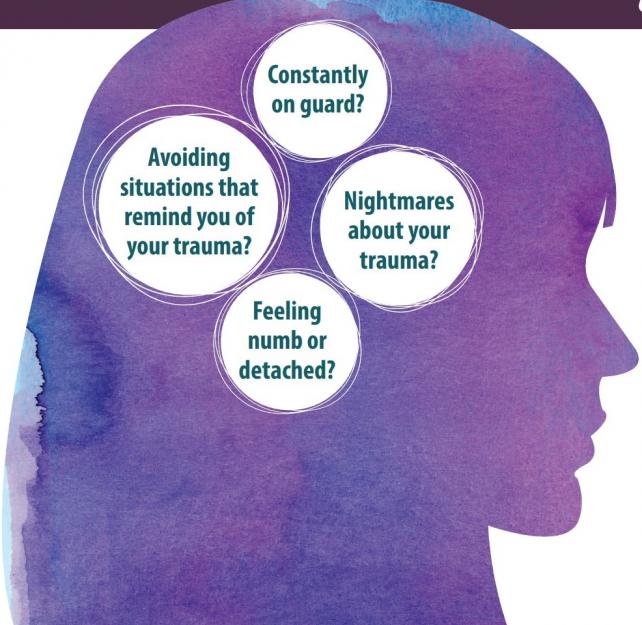
Trauma is common in women; five out of ten women experience a traumatic event. Women tend to experience different traumas than men. While both men and women report the same symptoms of PTSD (hyperarousal, reexperiencing, avoidance, and numbing), some symptoms are more common for women.
Here’s a TBI mind-twist: Looking forward to a holiday that just passed. All but forgetting that it’s already in the rearview mirror. “How does that work?” You might be asking.
Most people have stress reactions after a trauma. Having such a reaction has nothing to do with personal weakness. Stress reactions may last for several days or even a few weeks. For most people, if reactions or symptoms that feel like PTSD occur, they will slowly decrease over time.
Acute stress disorder (ASD) is a mental disorder that can occur in the first month following a trauma. The symptoms that define ASD overlap with those for PTSD.
Connor Martin's brother, veteran and athlete Kevin Ash, received a traumatic brain injury (TBI) that put him in a coma. Once he came out of it, though, he didn't seem able to communicate with Connor. It took some investigating to find out why.
Veteran Jonathan Warren got five CT scans and five MRIs over the course of his military career and each time they found nothing to explain his changed behavior. Then he got an EEG and everything changed.
Dr. James Kelly knows that many of those in the millitary receive "invisible wounds" while in service and those can go unnoticed. The Marcus Institute evaluates to see if a person for those wounds and then provides comprehensive care for the physical, emotional, and cognitive changes that can accompany trauma to the head using a combination of traditional and complementary treatments.
They say that hindsight is always 20-20…that we understand the ramifications of our behavior only from the perspective of looking back on that behavior.
Apps can change the life of a person with brain injury. People with TBI and their caregivers don't always realize how much the injury can impact their lives. For someone who is used to be able to do so many things the loss of those abilities is frustrating. Apps can help.
A veteran with TBI started using apps to help her in school while she was getting her master's degree. Soon she found those apps were being incorporated into her every day life, not just when she was in the classroom.
Apps are great tools for people with brain injury, but caregivers can help make them even more effective. If caregivers learn how the apps work they can provide support and troubleshooting, minimizing frustration and maximizing usefulness for someone with TBI.
Troubleshooting can be necessary when using apps after a TBI. Before giving up on the app and, if you can, check to see if it's a common issue for others. It maybe a simple fix.
There are many apps that can be helpful after a TBI. They should help with skills you need to support, but here are some options that might be what you're looking for.
Using apps after brain injury isn't about quantity, but rather quality. More apps doesn't equal more improvement. In fact, it can be too overwheming to be helpful at all. Instead, examine what skills you want to focus on and then find 5-6 apps that will help with those skills.
Self-regulation is an important skill and apps like PaceMyDay can be a great tool to learn your own limits and comfort levels. After a TBI this skill is even more important since those comfort levels have likely changed. How long you want to use an app depends on what you want or need.
The Pace My Day app allows people with a TBI to judge their stamina post-brain injury. By monitoring your energy levels and physical comfort using the app it's possible to learn how long you can perform a given task without feeling drained or in pain.
Kristi Kragthorpe finds the Pace My Day app to be an amazing tool for helping her to organize her day's activities, but to also monitor her energy levels.
Kristi Kragthorpe has found calender apps invaluable since her brain injury. She uses them to remember appointments, but also to keep track of how she's spending her energy.
Kristi Kragthorpe's accident left her with a brain injury. Her TBI resulted in a loss of balance, the ability to work with numbers, executive function, and taking initiative. Now she uses apps to help her gain back some of the functionality and independence she had before her TBI.