Use the filters to browse the information we have available or to narrow your search results for a specific audience (e.g. caregivers, military, children), a preferred type of content (e.g. videos, blogs, articles), or by topics of interest (e.g. family concerns, legal issues, symptoms).
With more than 266,000 diagnoses of TBI from the wars in the last decade, researchers are trying to create a "common data dictionary" that better differentiates among mild, moderate, and severe injury.
Dr. Anand Veeravagu talks about how Obama's BRAIN initiative will further advancements in research for TBI, stroke, Alzheimer's and other neurological conditions to the arena of clinical care.
Dr. Anand Veeravagu explains how a blast causes a swift change in pressure that generates a wave of wind, sound, and/or debris that, in turn, can damage a person's brain through a microtrauma or microbleed.
Dr. Anand Veeravagu describes this life-saving neurosurgical procedure, performed to prevent brain damage resulting from uncontrollable swelling in the brain.
Dr. Robert Cantu talks about various therapies like hyperbaric oxygen chambers and omega-3 fatty acids that may prove to be effective ways to treat brain injury, not just its symptoms.
People with TBI often had higher expectations for work and social life than their post-acute program staff recommended, a discrepancy partially attributed to TBI-related cognitive disorders.
"It’s my personal belief that the quality of fulltime care someone with TBI receives during the first two years post injury has the potential to greatly impact outcome."
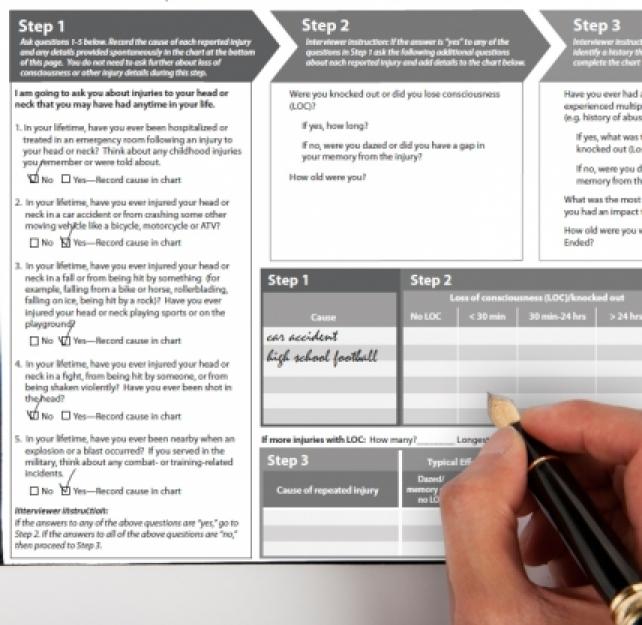
This presentation provides health care and social service professionals with an interview guide designed to elicit a patient's history of traumatic brain injury.
Not having coordinated medical care after a TBI can complicate matters, especially for adolescents who are trying to transition to independent adulthood.
The last thing Samuel Console, a retired Pennsylvania Army National Guard lieutenant, remembers after the explosion in Iraq was an orange flash of light. It wasn't until six years later he was diagnosed with brain injury.
Occupational therapist Kristen Maisano, OTD talks about how addressing sexual health as an activity of dailing living, just like eating, dressing, and bathing, normalizes it and helps patients with TBI and their caregivers connect again.
"With any kind of trauma — physical or psychological — there comes a sense of betrayal, and with that grief. Regaining a sense of personal control is critical."
Symptoms of TBI and PTSD can overlap, says Lt. Col. Jeffrey Yarvis, PhD, but sometimes treating the psychological ones first makes treating the neurological ones from there more effective.
Lt. Col Jeffrey Yarvis, PhD talks about Eye Movement Desensitization and Reprocessing therapy, which has been established by extensive scientific and clinical research as an effective treatment for PTSD.
Despite the pre-conceived ideas people may have about hypnotherapy, it is actually more about awareness and control than the lack thereof ... and can help people with TBI and PTSD.
Lt. Col Jeffrey Yarvis, PhD talks about how exposure therapy can be incredibly effective for service members with TBI and PTSD because it helps undo, or lessen, the effects of response-generated traumas.
Treatments for TBI and PTSD can often overlap since symptoms can overlap. However, if drug interventions are used, it is important to make sure there is no threat of negative drug interactions.
After making sure a patient is safe, healthcare providers could start with the question, "If life were to be better for your tomorrow, what would you notice?" The answer might be simply be a good night's sleep or feeling at peace.