

Brain Basics
Introduction
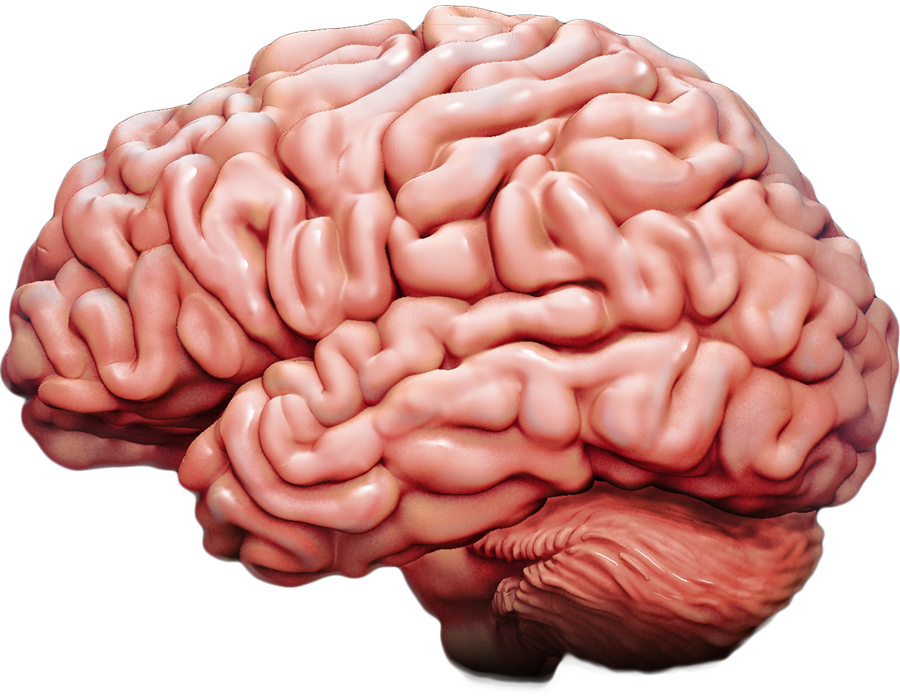
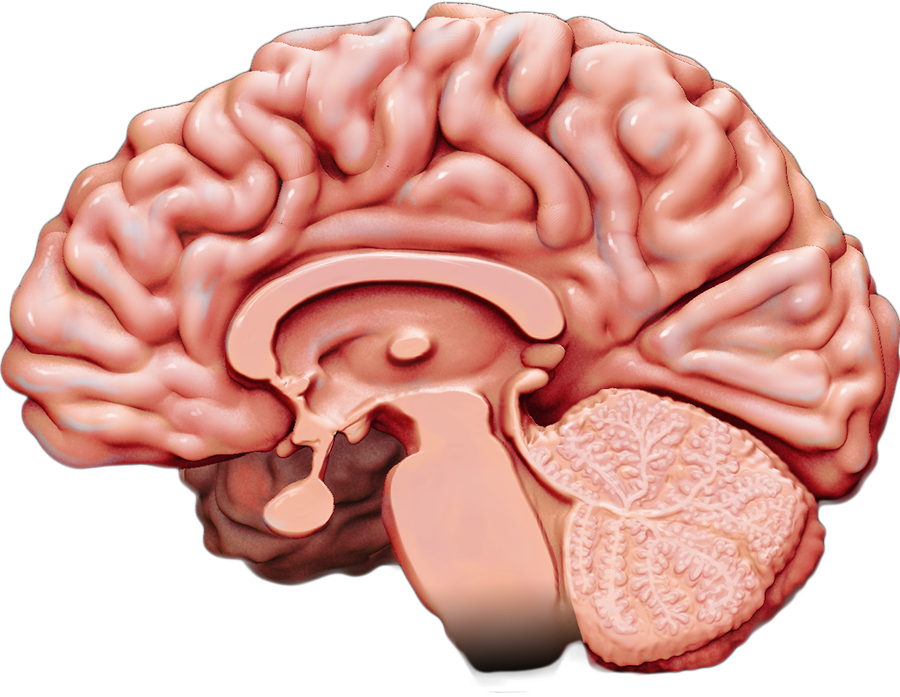
The brain is incredibly complex. Here we'll show you the major parts, where they are located, and some of what they are responsible for.
You can hover over the brain image to highlight different parts, and click them to see a description of that part, or tab through the slideshow controls to navigate to different brain parts.
The description of a part will include what might happen when it is injured. Please keep in mind that brain injuries can be as complex as the brain itself. A blow to one part of the head can potentially cause damage to the opposite side or even throughout the brain.
Frontal Lobe
Located behind the forehead, the frontal lobes are the largest lobes of the brain. They are prone to injury because they sit just inside the front of the skull and near rough bony ridges. These two lobes are involved in:
- planning & organizing
- problem solving & decision making
- memory & attention
- controlling behavior, emotions & impulses
The left frontal lobe plays a large role in speech and language.
Problems After Injury
Injury to the frontal lobes may affect:
- emotions & impulses
- language
- memory
- social and sexual behavior
Parietal Lobe
Located behind the frontal lobes, the parietal lobes:
- integrate sensory information from various parts of the body
- contain the primary sensory cortex, which controls sensation (touch, hot or cold, pain)
- tell us which way is up
- help to keep us from bumping into things when we walk
Problems After Injury
Damage to the parietal lobes may result in:
- an inability to locate parts of your body
- an inability to recognize parts of your body
Temporal Lobe
The temporal lobes are located on the sides of the brain under the parietal lobes and behind the frontal lobes at about the level of the ears. They are responsible for:
- recognizing and processing sound
- understanding and producing speech
- various aspects of memory
Problems After Injury
Damage to specific parts of the temporal lobe can result in:
- hearing loss
- language problems
- sensory problems like the inability to recognize a familiar person’s face
Occipital Lobe
Located at the lower back of the head, the occipital lobes:
- receive and process visual information
- contain areas that help in perceiving shapes and colors
Problems After Injury
Damage to the occipital lobes can cause:
- visual field defects
- distorted perceptions of size, color, and shape
Cerebellum
Located at the back of the brain, the cerebellum controls:
- balance
- movement
- coordination
The cerebellum also allows us to:
- stand upright
- keep our balance
- move around
Problems After Injury
Damage to the cerebellum can result in:
- uncoordinated movement
- loss of muscle tone
- an unsteady gait
Brain Stem
Located at the base of the brain, the brainstem is composed of the midbrain, the pons, and the medulla. It regulates basic involuntary functions necessary for survival such as:
- breathing
- heart rate
- blood pressure
- swallowing
It also plays a role in alertness and sensation.
Problems After Injury
Injury to the brainstem can disrupt basic functions so that they are no longer regulated automatically. These functions can include:
- heart rate
- breathing
- swallowing
Hypothalamus
Located below the thalamus and above the brain stem, the hypothalamus:
- helps us regulate body temperature
- helps us realize when we are hungry or thirsty
- plays a role in what mood we might be feeling
- releases and controls many hormones that we need to function
Injury to the hypothalamus may affect:
- sex drive
- sleep
- hunger
- thirst
- emotions
Pituitary Gland
Located at the base of the brain, the pituitary gland:
- regulates and releases important hormones to our body
- plays a big part of our overall well-being
Injury to the pituitary gland may affect:
- growth in children
- blood pressure
- fatigue
- depression
- sex drive
- body temperature
- pain
Amygdala
Located near the hippocampus in the frontal portion of the temporal lobes, the amygdala:
- are invovled in the formation and storage of information related to emotional events
- facilitate long-term memory formation
- convert and retain learning from pleasure responses
- help us recognize when we are in danger or fearful of something
Injury to the amygdala may affect:
- memory formation
- emotional sensitivity
- learning and rentention
- depression
- anxiety
Hippocampus
The hippocampus is located in the medial temporal lobe. The cells in the hippocampus are hypersensitive to oxygen loss or lower blood flow in the case of a brain injury. The hippocampus:
- is responsible for memory creation and retention
- helps us create new memories
- helps us orient ourselves in our surroundings
- facilitates our ability to navigate and find our way around the world
Injury to the hippocampus may affect:
- new memory creation
- new memory retention
- mood
- confusion
- disorientation
Comments (98)
Please remember, we are not able to give medical or legal advice. If you have medical concerns, please consult your doctor. All posted comments are the views and opinions of the poster only.
princessqt5492 replied on Permalink
Wish I had this information while I was taking my A&P Class to help with studying. Thank you for sharing.
Anonymous replied on Permalink
could you make something about lucid dreaming?
Anonymous replied on Permalink
This is cool
Anonymous replied on Permalink
wow so helpful!!!!!!!!!!
Molly Carrigan replied on Permalink
This is really cool. I didn't know about the brain until now. This is going to really help in our unit for Brain Science. Thank you!
Jackson Bennett replied on Permalink
Awesome
Me replied on Permalink
This is amazing!
Anonymous replied on Permalink
*W O W*
Anonymous replied on Permalink
Very useful. I love this!
Anonymous replied on Permalink
It is great to know that we have another organ beside the amygdala , hippocampus, that help us to create new memory! It is a relief for people like me, that had their amygdala removed though surgery, to know that we can relied on extra help from other organ.
I think that the hippocampus has help me to create and keep my short and long memory functioning, of course with persistency and hard work. Through my years of learning, I have learned to used strategies that has helped to learn: reading the material several times and taking notes in English and Spanish (translate and interpretation of information) which has help to overcome my obstacle with memory retention.
my brother alwa... replied on Permalink
this is amazing
Anonymous replied on Permalink
amazing
Anonymous replied on Permalink
wow I did not know there's that much stuff about the brain
Anonymous replied on Permalink
Cool! I used this on a test.
Andrew replied on Permalink
This is good to know because what happen if you need it on a test
Suzanne M Jenson replied on Permalink
Help please: I have had a BI since 1999. Everything has been going pretty awful until now. I feel. I talk, A whole lot lot worse than ever before. I am at a loss. I used to be able to talk without a problem. Now, it has really gone downhill. I don't understand. This is so important. Can I use a drug or something to clear up my voice? I as BI in 1999, and have never experienced this problem before. HELP wanted, needed quickly.
Anonymous replied on Permalink
Teacher loved this page!
Anonymous replied on Permalink
i used this on a test
jeffery replied on Permalink
This is good to know
Kelly replied on Permalink
That is really cool to learn about
Anonymous replied on Permalink
cool brain
Anonymous replied on Permalink
I served in the Persian Gulf from 1990-1991 I am having issues with memory loss, and cognitive functions, and also experiencing paralysis on my right side with my leg and arm.
I am reaching out to see if any other veterans are experiencing this medical issues.
Thank you,
Dave Morrison
Anonymous replied on Permalink
Where are the cerebrum and thalamus??
kemiwemi replied on Permalink
i guess something is wrong with my amygdala :)
Maria D, Castillo replied on Permalink
It is great to know that we have another organ beside the amygdala , hippocampus, that help us to create new memory! It is a relief for people like me, that had their amygdala removed though surgery, to know that we can relied on extra help from other organ.
I think that the hippocampus has help me to create and keep my short and long memory functioning, of course with persistency and hard work. Through my years of learning, I have learned to used strategies that has helped to learn: reading the material several times and taking notes in English and Spanish (translate and interpretation of information) which has help to overcome my obstacle with memory retention.
Anonymous replied on Permalink
nice brain
Maddie replied on Permalink
What software was used to make this diagram? As this was really easy to understand and use and I would love to make more diagram in this format and style to add to my studying.
Anonymous replied on Permalink
cooooooooooooooooooooooooooool!
Someone replied on Permalink
Good 4 u
Anonymous replied on Permalink
if we don't have a part of the brain what gonna happen
Anonymous replied on Permalink
i didnt know what the thing on the back of your brain was called now i do and know what it does
millie replied on Permalink
Hope you are ok now!
Patrick replied on Permalink
30 years ago I went through the last of three surgeries in my early twenties to remove scar tissue on my right temporal lobe that caused epilepsy. I did well on all the post surgery cognitive and related tests at the time. However, all wasn't perfect. I have struggled on my own over the years, not knowing the issues I experienced were not normal. I have managed to do good in school and my career by self-creating my own techniques to help remember things and improve my ability to perform tasks. The internet wasn't around to help me realize that others were going through the same things. I just found this site today and am glad to learn more. My only issue I have been struggling with in recent years is that you feel you need to announce to everyone you work with that you had a brain injury/surgery, so you are not in the rumor mill for being slower than other employees and have other mild issues that normal people may think is odd. For me, I repeat things a lot, can process a little slower, and have some peripheral vision loss. I am looking for another job now because my current work environment is not a pleasant environment even for a person without my issues.
Anonymous replied on Permalink
It is nearly 18 months too late? but maybe not. Go see a neuroscientist AND a neurologist AND perhaps a neurosurgeon. They each do different things but you should be able to get some answers. Good luck & my prayers are with you. May God get this message delivered to you. Take care.
Anonymous replied on Permalink
https://www.brainline.org/treatment-hub/treatments-brain-injury/memory-s...
Linda replied on Permalink
what exercises for memory ? What techniques?
Anonymous replied on Permalink
I love that I can learn all of this info
Anonymous replied on Permalink
That was a lot of information to learn of the brain. I like how it tells everything about the parts of the brain.
Carla Shaw replied on Permalink
I can relate to your story and I am in a struggle for my sanity. I have had no therapy and I don't feel understood by anyone. I have quit bathing and I have little contact with even my husband and son. I am in constant state of pain which brings on debilitating seizures. My husband has said I am embarrassing and I don't want my son to see anymore. He was 3 when I wrecked and now he is 17. After the wreck I hid a lot of my feelings due to being accused constantly of abusing my medication. I couldn't lose my baby. When my son was in middle school I wrecked picking him up from school from a seizure and had to stop driving. I remember that all to well. I would never hurt him. Why did no one see I needed help i could not have hid that well and how do I get up. I am so tired. Things have spiraled out of control. I have not one relationship in my other than my best friend from high school. I stay out of the way.
lray2345 replied on Permalink
Neuropsych can assist you or seek treatment from a speech therapist. They can do some cognitive exercises to assist with memory.
G.K.S replied on Permalink
Amen for good thing.
Anonymous replied on Permalink
Amen
Vicki replied on Permalink
You've turned a tragic experience into a true blessing and a service! The light of God surrounds and fills you. Always.
Anonymous replied on Permalink
I was in a head on collision in 1995. I still do not any events of that day or months that led up to the accident. I was life flighted and died twice. Brain bleed and sever swelling along with collapsed lung. When I awoke 17 days after I didn't believe I was in an accident eventhough I was still in hospital. I had lost about 5 years of memory. Little specks of memory piece by piece and the majority was back. Except months leading up to the TMI. Since the accident I can not remember names. Even customers I see monthly for years. I know the face but not a name. I must ask and enter in computer and write it down and still no memory of it the next day.
Now at the age of 50, 25 years later I am having bigger issues with my memory that frightens me and I would love to learn about treatment. Now I can't remember tasks. I can't retain computer programs or where to go to find what. I will tell someone I will check on something and call them back and if I get interrupted before I speak to them again, I forget. I write notes and reminders and sets alarms in my phone if I remember to or don't get distracted. In this busy life, distraction is normal. I now work in an office by myself. I fear my co workers or boss will discover the problems I'm having and I'll lose my job. Life has become extremely difficult and stressful. I have always been an over achiever. Goal originated and now I could care less.
Does anyone have any recommendations?
I just had a complete blood profile done and nothing irregular was found.
I hope someone can tell me or guide me in a direction to reverse what is going on. I NEED HELP.
Peter replied on Permalink
Sorry to hear, but take this advice from someone who's been on the receiving end of a TBI; His ADHD will be worse for sure, but most importantly he will not ever be is "old self" Hes changed. From his perspective his whole entire world and the lens he sees it through have changed. You just need to talk to him and actually listen and let him be whoever he wants to be. Its going to be a long time before hes comfortable with his new understanding of life but if you just support him and tell him everythings going to be okay and most importantly listen to him. His words will have more weight now than ever before.
Aaron replied on Permalink
I had a similar event from a fall off a scooter. I don’t remember the first 2 weeks due to medication. I spent a total of 10 weeks in inpatient or outpatient rehab and went back to work after 10 weeks. Things are mostly the same as they were from most people’s perspective. My family always looks for what’s different and I know what things still give me additional stress or fatigue. I’ve learned that I’ve been blessed and most people don’t improve as fast or as far. But that being said, there’s still things I know that are slightly harder than before. I’m at week 16 today so it’s hard to say how my case can help you understand your son’s. What I can say is it’s helpful when I don’t feel like I’m under a microscope. It’s helpful when my family doesn’t tell me I’m not better. Time is needed and some things might not go back to the original. As far as adhd, Im an adult who never had that issue, but I will say my perspective on life changed. I’m calmer most of the time and very thankful and appreciative of people who helped me along the way. For kids, things change over time. If my parents compared my 14 year old self with my 18 year old version, I’m not sure they’d think I was the same. God listens to prayers so keep saying those. I’m certain that’s why I’m still here, and very thankful every day. Good luck. I’ll pray for your son.
Anonymous replied on Permalink
When i was a junior in college someone tried to murder me, they tried to slit my carotid artery but they didnt cut deep enough. it left me with extreme pain and i constantly pass out because the blood flow running to my brain was disrupted. The only reason I survived the attack was because I had a small katana in I turned around and stabbed the attacker. It was my dad. I still cry to this day. I am 38 now with 3 kids.
Sandy replied on Permalink
I have a 14 year old son who on May 31 was in a bad car accident. He was life flighted to local Children's hospital. Where he had two small brain bleeds and swelling. He was placed into medically induced. Coma so he would stay calm. He was in there for about two weeks maybe three. He was the. Sent to a children's rehab was there two weeks And is home now. Doing really well. He did have Adhd. before the accident. He is in school boys scouts and speech therapy once week. My question how long before he gets back to his old self. And could the accident make his Adhd worse.
Anonymous replied on Permalink
I have a very bad frontal lobe.
Syeven B replied on Permalink
This reading will allow me to ask more questions to my doctor about thins i feel they don't know about me,
Pages