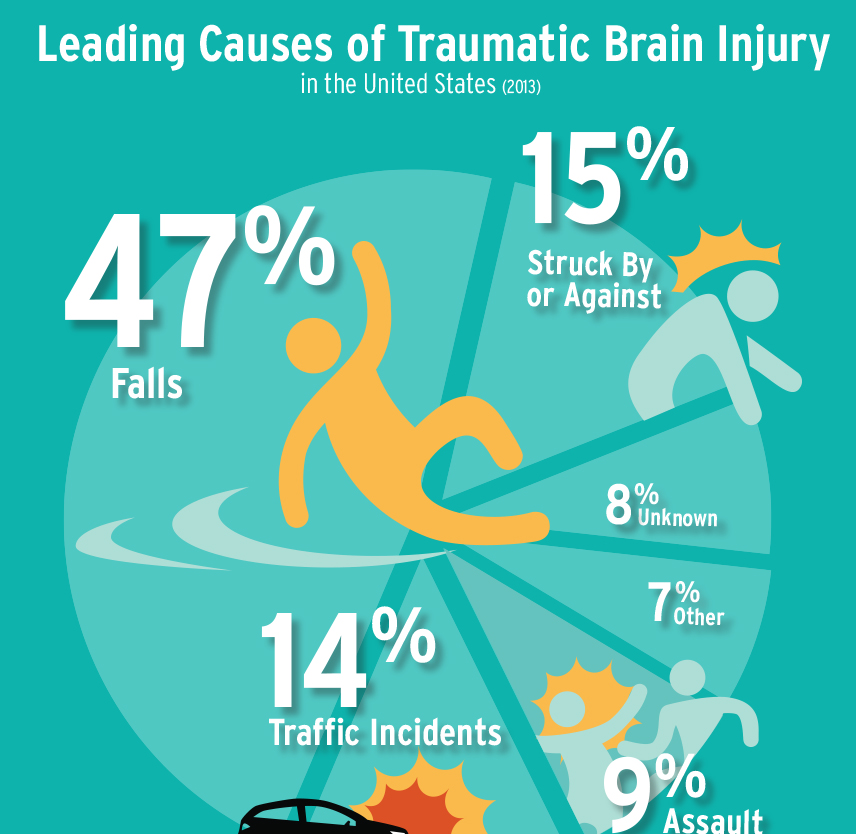
An acquired brain injury indicates damage to the brain caused by an event or disorder, such as a tumor, stroke, or traumatic injury. Traumatic brain injury (TBI) is more specific as it implies trauma to the brain caused by an external force affecting the head and brain. An example of an external force is a car crash.
Even more specific is closed versus open head injury. Closed simply means the cranial contents have not been penetrated and there is no air inside the protective layers of the brain. Open means the skull and other protective layers are penetrated and exposed to air. A classic example of an open head injury is a gunshot wound to the head. A classic closed head injury is one that occurs as the result of a motor vehicle crash. The abbreviations used are CHI (closed head injury) and TBI (traumatic brain injury).
The TBI Model Systems (TBIMS) is a group of 14 medical centers funded by the National Institute on Disability and Rehabilitation Research (NIDRR). The TBIMS works to maintain and improve a cost-effective, comprehensive service delivery system for people who experience a traumatic brain injury (TBI), from the moment of their injury and throughout their life span.
The criteria established by the TBIMS states that for someone to have a TBI, one of the following has occurred:
A common question is, "Can someone have TBI but never lose consciousness?" If you look at the Model System’s definition, the answer is yes. An individual can have amnesia for the event or an abnormal CT scan, but not lose consciousness. Someone with an open brain injury, like a penetrating gunshot wound, may not lose consciousness. The person comes into the ER and can ask for help even though they are significantly brain injured. So it is possible to have a TBI without loss of consciousness.
Glasgow Coma Scale Score
A common method used to measure the severity of a traumatic brain injury is the Glasgow Coma Scale (GCS) score. The GCS score ranges from 3 to 15. It is based on the person’s best verbal response, ability to follow commands, and eye opening. A score of 3 means that a person has no eye opening, is not making a sounds or talking, and is not responding even to pain (and so is not following commands). This reflects a very severe TBI. Someone with a score of 15 has their eyes open, is following commands, and is talking (even to the extent of being oriented). By definition a GCS score of 8 or below reflects a severe TBI, a score of 9-12 a moderate TBI, and a score of 13-15 a mild TBI. The first GCS score is often done at the roadside by the EMTs. In many instances, moderately to severely injured people are intubated (a tube is placed down the throat and into the air passage into the lungs) at the scene of the injury to ensure the person gets enough oxygen. To do the intubation the person must be sedated. So, by the time the person arrives at the hospital he/she has already received sedating medications and has a breathing tube in place. Under these conditions it is impossible for a person to talk, so the doctors cannot assess that part of the GCS. People in this situation often receive a "T" after the GCS score, indicating that they were intubated when the examination took place, so might see a score of 5T, for instance. The GCS is done at intervals in the neurointensive care unit to document a person’s recovery.
CT or MRI Scan Results
The cranial tomography (CT) scan is an X-ray procedure that provides the physician a picture of the brain that allows detection of disorders, such as bruises, blood clots, and swelling. The procedure is not painful and usually people with moderate to severe TBI will have several CT scans during the course of a hospital stay to keep track of any lesions that have been noted. In some cases, a magnetic resonance imaging (MRI) scan may also be performed. This also creates a picture of the brain based on magnetic properties of molecules in tissue. It is not an X-ray procedure. Use of an MRI might is restricted if there is any metal around the person, such as part of some medical devices. Although most people with severe TBI will have an abnormality on a CT scan or MRI scan, it is possible to have a severe TBI and be in coma even though the scan results are normal. This is because the scan cannot detect all the types of injury that can occur to the brain.
Duration of Post-Traumatic Amnesia
One of the better estimates for severity of a brain injury is post-traumatic amnesia (PTA). Anytime a person has a significant blow to the head they will have amnesia for the event. They do not remember the injury and possibly events for sometime afterwards. This is the period of post-traumatic amnesia. The longer the duration of amnesia, the more severe the brain dysfunction. If the duration of amnesia is up to an hour, it is considered a mild trauma; up to a day of amnesia signifies a moderate injury; up to a week of amnesia after the injury is considered a severe injury. Beyond a week of amnesia, the injury is considered very severe. How do you know if someone is in the midst of post-traumatic amnesia? Typically, the person in PTA has no recall of recent events. They might not recall having spoken to you just a couple of hours ago and may make repetitive comments.
Associated Injuries
When dealing with traumatic brain injury, there are often other injuries as well because many TBIs occur as the result of falls or car crashes. Fractures of arms, legs, and ribs are common. Bruising to the lungs and other internal organs can also occur.
On the other hand, it is possible for someone to have only a TBI with no other trauma. In this situation, families may have a difficult time understanding the seriousness of the brain injury when they see their family member in the NICU. The injured person may not have a mark on their body to show any injury.
From University of Alabama at Birmingham. Used with permission. www.uab.edu/tbi.
my son had a car accident and he sustained epidural /subdural hematoma was home on christmas day, ambulates now, however still has 4/10 neck pain when he turns to his sides, headache intermittently, upper thoracic and lower back pain, and what bothers me most is his balance and disassociation of the memory from recent activities
My son was just in a traumatic accident last friday leaving school and spent the entire weekend in the hospital and only came home today...he lives with his father and this is what I was told. He hit the pavement from a moving vehicle and injured the frontal lobe. if there is anyone who can tell me about this kind of injury first hand as in a Dr. of this kind of injury, please dont' hesitate to write me, or direct me to other helpful sites. thanks, Lisa J.
Very informative! The brain is a very complex organism. Brain trauma can have severe effects on this delicate web of organisms. The brain can be compared to a computer only much more advanced. Overall it still remains a mystery even though we know the various components and their functions. I find the brain to be a fascinating organism.
I was hit in the occipital lobe by a bomb blast and shrapnel during the Vietnam Era. I wonder if there is any researchon the long term effects of shrapnel in the the brain. I am always concerned that another injury like concussion could have severe impact.
May 9th, 2011 8:34pm