

A neighbor of mine who just returned from his second deployment to Afghanistan told me he received a comprehensive vision test at the polytrauma hospital where he was treated for his brain injury. What would this kind of screening involve and is it available to non-military people who sustain a brain injury?
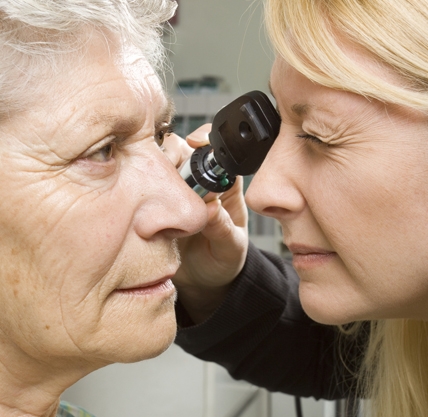
The kind of vision screening your neighbor probably received would basically be an eye health examination — similar to an annual eye exam from an ophthalmologist or optometrist — but it would also look specifically at more subtle changes. A comprehensive visual exam like this would include testing for:
- occult eye injury – an eye injury that appears to be asymptomatic.
- visual acuity loss – the loss of visual clarity due to damage to the eye, the nerve fibers that carry signals from the retina in the eye to the brain, or to the visual cortex.
- visual field loss – the inability to see part of your visual field. For example, you cannot see the left side of your “world.”
- contrast sensitivity loss – the inability to see objects that may not be outlined clearly or that do not stand out from their background. For example, it would be difficult to see a shade of gray on a white background or to see white on a light gray background.
- binocular or oculomotor motor dysfunction - trouble with both eyes coordinating with one another.
Anecdotally, we’re seeing a number of service members who experienced blast events in combat and who don’t necessarily have any physical damage to the eye, but may have early onset issues like glaucoma or retinal detachment, issues we would usually expect to see in people as they age. For civilians, the type of visual exam they receive will depend on whether their ophthalmologist or optometrist is part of an interdisciplinary TBI team, or if the patient was referred to a vision specialist by his regular doctor. A comprehensive vision examinations after a brain injury should be part of an interdisciplinary evaluation of someone with a TBI — civilian or military.
About the author: Gregory Goodrich, PhD
Dr. Goodrich received his PhD in Experimental Psychology in 1974 from Washington State University. His career with the US Department of Veterans Affairs began in 1974 and he is currently supervisory research psychologist (Psychology Service) assigned to the Western Blind Rehabilitation Center.

Comments (1)
Please remember, we are not able to give medical or legal advice. If you have medical concerns, please consult your doctor. All posted comments are the views and opinions of the poster only.
Anonymous replied on Permalink
Thanks for the great information on eye exams. I was very scared going into my first eye exam. But with this info I find it quite a bit more easy. Thank you for taking the time to post.