

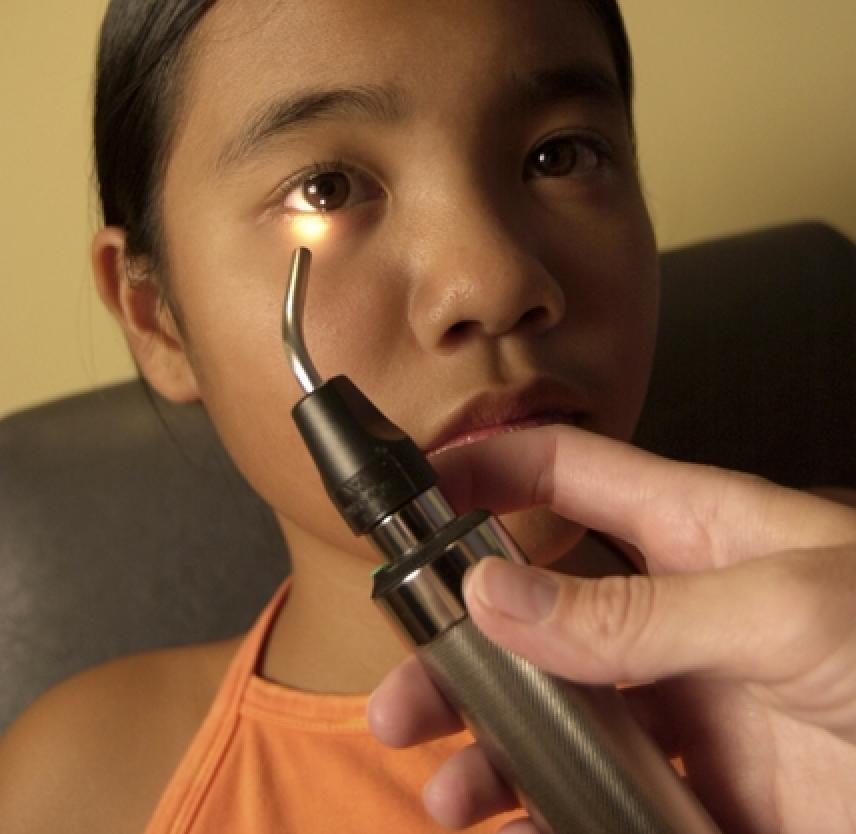
BrainLine sat down with Dr. Gregory Goodrich to talk about the problems with vision that can arise after a traumatic brain injury. Dr. Goodrich is the supervisory research psychologist assigned to the VA Western Blind Rehabilitation Center in Palo Alto, California. He also serves as the program coordinator for the Optometric Research Fellowship Program at the VA hospital in Palo Alto.
How common is it to have vision problems after traumatic brain injury (TBI)?
For TBI in general, the literature says 20-40 percent of people with brain injury experience related vision disorders; however, the exact prevalence is not known. 1, 2
In the military population — although we don’t have a definitive statistic — we have found in mild TBIs that troops exposed to one or more blasts can have trouble with their eyes coordinating with one another, what we call “oculomotor or binocular dysfunction.”
In moderate to severe TBI, about one third of the troops tested have some sort of visual impairment, which can include visual acuity and field loss, binocular dysfunction, and spatial perceptual deficits.
Complete visual examinations are now a required part of testing for brain injury in all four VA polytrauma centers, which will help with data collection since, until this mandate was passed, comprehensive visual examinations were not an integral part of interdisciplinary protocols for brain injury. The hope is that in the future this comprehensive test will be part of any evaluation of someone with a TBI whether civilian or military.
What are the tests for visual problems like currently?
To date, if a person has a traumatic brain injury, he is not given a full visual examination. What is administered most often is a basic test called the Confrontation Visual Field Test, or CVFT. Basically, it consists of a doctor standing at arm’s length away from the patient, wiggling his fingers in different areas of the person’s visual field, and saying, “Can you see this?” This is a good, quick-and-dirty test, but unfortunately, it often misses significant visual problems.
Comprehensive visual examinations include the types of examinations you would receive normally for annual ophthalmological and optometric examinations. They look at eye health, refractive errors, visual fields, contrast sensitivity, and so on. What is unique about these comprehensive examinations is that they include examinations for occult injury, binocular function, and other specialized testing which goes beyond what is normally provided. In short, they are designed to detect vision disorders which are not commonly seen by clinicians and which require specialized testing to uncover.
Again, we hope that soon a complete visual examination will be a requirement of an interdisciplinary evaluation of someone with a TBI — civilian or military.
What are the most common kinds of visual problems?
The two big categories are visual acuity loss and visual field loss.
Let’s start with visual acuity loss. If a person wears prescription glasses and takes them off, he will have a loss of acuity — or clarity. With brain injury, people can have a relatively small visual acuity loss or significant loss.
Visual acuity loss results from damage to the eye, the nerve fibers that carry signals from the retina in the eye to the brain, or to the visual cortex. This loss can sometimes be effectively treated with glasses, magnifiers, or electronic reading aids such as closed-circuit televisions. How much the loss impacts an individual’s life depends on the degree of the loss. Needing a small amount of magnification is in some ways similar to those of us who need bifocals. A need for more optical magnification than that can require different devices and training.
Visual field loss is a bit more complicated. Think of your visual field as a pie. Visual field loss is categorized by which part of the pie is affected.
- If you have hemianopsia, half of your pie — or visual field, either vertically or horizontally — is gone; you cannot see it.
- If you have quadranopsia, a quarter of your visual field is lost.
- If you have homonymous hemianopsia, the same quarter or half is lost in both eyes.
- If you have bitemporal hemianopsia, you are missing the outer half (or inner half) of both the right and left visual field.
Hemianopsia and quadranopsia are the most common types of visual field losses; but going back to the pie analogy, other types of field losses include loss around the edges of the pie or loss from the middle going outward. And, of course, there can be differing combinations depending upon the individual injury.
Visual field loss is caused by damage to the nerve fibers that carry the visual signal from the eyes to the visual cortex and/or connect operations between different parts of the brain.
Are these vision problems temporary or permanent?
Just like people, all brain injuries are unique, and that includes the process of recovery; so it is difficult to generalize. After a brain injury, once the person is medically stable, we will start visual rehabilitation. If the visual problems resolve, great; if not, we have a head start by starting that early. Vision is integrated into other problems that can occur post-TBI like muscular imbalance and vestibular problems (dizziness, imbalance, vertigo, etc.)
Can people with brain injury suffer from both kinds of vision loss?
Yes, people with TBI can suffer from both visual field loss and visual acuity loss. After all, 40-50 percent of the brain is involved in vision; so if a person’s brain is damaged in a specific location or several locations, there is a high probability that his vision will be affected in some way.
If someone has hemianopsia can they learn how to compensate for that, or “see” it?
Broadly speaking, there are two kinds of visual field losses — those with neglect and those without neglect, and this is a huge oversimplification but perhaps useful to begin understanding field loss.
Let’s take your example of the woman who has hemianopsia, and she can’t see the left side of her world. If she has hemianopsia with neglect, she doesn’t even know that the left side of her world exists. It’s just not there. She has no awareness of its existence. She might look in the mirror and only comb the right side of her hair, or apply mascara only to the right eye. She doesn’t know she is ignoring her left side because she has no awareness that it exists. Because of her complete lack of awareness, it would be challenging, but possible, to teach a person like this compensatory strategies.
If she has hemianopsia without neglect — if she has retained an awareness of the lost side of her vision — she can learn compensatory strategies to “search into” that side of her world. Such strategies include scanning, moving the head from side to side, and re-teaching her eyes to move and look into the missing areas.
What other techniques and compensatory strategies do you use?
In rehab, there are various techniques we can use to help people with visual problems after TBI. For someone with visual acuity loss, we teach them the importance of better lighting, the use of magnification, and strategies or assistive technologies to make reading or using the computer easier. Prescription glasses or contacts may also help.
For people with visual field loss, we give them specific strategies to scan their environment, based on where their hemianopsia is located.
For example, if a man has lost the bottom half of his visual field, he is at greater risk of falling off a curb, tripping over a threshold, or falling over a skateboard left in the driveway. So we will teach more efficient scanning processes — ways for him to scan the ground, to move his eyes and head down and around to prevent falling and tripping.
For some people — and this is ideal, of course — problems like hemianopsia after TBI resolve themselves. For others, it doesn’t, and learning scanning processes and other strategies can take a short time or weeks before a person reaches his maximum level of independence.
The length of time for learning compensatory strategies depends on a person’s cognitive level post-injury. For someone with TBI who has more cognitive impairment, has perceptual deficiencies, and has less awareness, the rehab will be harder. This person may be able to see the skateboard in the driveway, but he may not be able to connect seeing it to the fact that he needs to walk around it.
What professionals help a person learn these strategies and compensations?
You might think I’d answer with just ophthalmologists and neurologists, but I want to emphasize the importance of interdisciplinary rehabilitation for people with brain injury. An interdisciplinary team can include nurses, physical therapists, occupational therapists, speech-language pathologists, physical medicine and rehab physicians, neurologists, neuropsychologists, audiologists, ophthalmologists, and so on. And each one of these professionals may play a part in rehabilitating vision.
Let me give you an example of how an interdisciplinary team worked with one of our patients. Among other issues resulting from his brain injury, the patient had a left hemianopsia with neglect; he was unaware that the left side of his world existed. He was mostly confined to bed. His nurses, who spent the most consistent time with him, noticed that the way his bed was positioned precluded him from being able to see who was coming into his room, which made him more agitated and less confident. So they suggested to the team that they move his bed so that the door was by his right side, enabling him to greet staff or visitors. As he got stronger and more confident, the nurses, in continued collaboration with the interdisciplinary team, then did the opposite. They moved his bed so that the door was by his left field of vision, the half that was lost. By doing this, he had to work on scanning — moving his head and eyes beyond his right visual field — and also learning to listen for audio cues.
Especially because each brain injury is unique, an interdisciplinary team is a matter of “more heads are better than one.”
When does a brain injury result in blindness?
Blindness can come from a penetrating injury like a gun shot or a non-penetrating injury like a blast in combat. It can also be a result of an injury to the back of the head — like from a fall — that destroys or damages an area that coordinates signals between the brain and the eyes. In this case, the eyes could be perfectly normal, but the function in the brain allowing the eyes and brain to communicate would be damaged and no longer work. Our experience with troops returning from the current wars suggests that total blindness is less common than other visual losses; perhaps occurring in 2-4 percent of all cases.
Are vision problems after blast injuries different from vision problems after a car crash or sports injury?
So far we think that blast injuries and injuries from a car crash or a sports injury produce similar visual problems. However, we lack a good understanding of how exactly a blast causes brain injury. Blasts cause injury not just by the brain banging around in the head; but they also add torsional forces. (Picture a plastic ruler being twisted between both hands, each hand twisting it in the opposite direction. The ruler would be in a state of torsion.) The brain being twisted in this way may cause shearing, which is basically the stretching and tearing of the tiny nerve cells that comprise the brain and/or the blood vessels which provide nourishment to the nerves.
But all we can say now, based on the evidence we have, is that the visual consequences from blast and non-blast brain injuries appear very similar. Until we clearly understand how blast injury occurs, we should be cautious in interpreting our findings.
How do visual deficits influence quality of life?
Having visual deficits after a brain injury can definitely interfere with a person’s quality of life. Visual problems often go hand-in-hand with cognitive or physical problems and also with psychological problems like depression. If a person cannot see well, he may isolate himself because he doesn’t want to be out in the world bumping into people or losing his way. He may have a fear of crowds or may feel embarrassed that he can’t read the expressions on his friends’ faces. This social isolation can be devastating and can then lead to depression, anxiety, and substance abuse.
What advice would you give someone after a TBI who is experiencing visual problems?
I would say if following a brain injury the person has any visual symptoms at all — even a little blurriness or fuzziness, eyes that fatigue easily, difficulty reading, or frequent bumping into things on one side more than the other — he should get a comprehensive eye examination by an ophthalmologist or optometrist. A comprehensive test would include testing the visual field and acuity, contrast sensitivity, and binocular vision. Make sure to find out if the symptoms are related to the visual system or something else … that is, are the symptoms a result of the brain injury or is it a simple need for a new pair of glasses? Try to find an optometrist or ophthalmologist who has experience working with people with brain injury. And keep persisting until you get the help you need.
Footnotes
1 Gianutsos, R. (1991). Computerized screening: Visual field deficits after brain injury. Journal of Behavioral Optometry, 2(6), 143-150.
2 Kerkoff, G. (2000). Neurovisual rehabilitation: recent developments and future directions. Journal of Neurology, Neurosurgery, and Pscyhiatry, 68, 691-706.
Gregory Goodrich, PhD
BrainLine sat down with Dr. Gregory Goodrich to talk about the problems with vision that can arise after a traumatic brain injury. Dr. Goodrich began his career with the U.S. Department of Veterans Affairs (VA) in 1974 and is currently supervisory research psychologist (Psychology Service) assigned to the Western Blind Rehabilitation Center in Palo Alto, California. He also serves as the program coordinator for the Optometric Research Fellowship Program at the VA hospital in Palo Alto. His primary areas of research are low-vision reading and mobility. Most recently, his research has focused on the treatment of polytrauma veterans with visual loss returning from Iraq and Afghanistan.
The opinions expressed are those of Dr. Goodrich and not those of the Department of Veterans Affairs.
BrainLine
Comments (61)
Please remember, we are not able to give medical or legal advice. If you have medical concerns, please consult your doctor. All posted comments are the views and opinions of the poster only.
Rich H replied on Permalink
I really hope everyone is doing well, I've been improving with my vision problems since my 2 concussions. Getting a good vision therapist has so many benefits, as well as going to a clinic that understands you and your symptoms.
Double vision, blurred vision, problems with gait, and switching to long and short distance, photo sensitivity. All these issues can be troubling, especially combined with the other concussion issues that aren't visual.
Its important to try to deal with the concussion symptoms holistically and also take it one step at a time. Good Luck, and thanks for the great information.
Jane Gilman replied on Permalink
I have had a TBI since a car accident in 1992. I am having problems seeing accurately to my right. I have knocked off the passenger side mirror several times. A friend sent me a copy of this document connecting TBI to vision problems. My Optometrist tested my field of vision and said I was fine, but I don't think so. Is there a professional in NH whom I could see for help in this area? Jane Gilman. Thanks
Anonymous replied on Permalink
I had a sTBI in 2014 and in 2018 the severity of visual disturbances dramatically increased. I've been to an optometrist, 2 opthamologists, 2 neurologists and the diagnosis was lateral heterophobia. I look at the symptoms and I don't think that's what I have. I have been resarching symptoms of conditions for roughly a year and a half because I can't get a direct diagnosis. I came across a condition called photopsia, and one of the first symptoms was a list of colors that are uncomfortable to look at and white was the first color which made me think I finally found what my problem is. I know I can't self diagnose but the best way I can describe my visual disturbance is flickering static. I have not been asked if the disturbances flicker, and I think that would have lead to a more accurate diagnosis. I want to rip my eyeballs out. In June it will be 2 years of these disturbances that have not improved and are starting to get worse. My opthamologist told me my new lenses should help, because my first lenses never took it away but it helped for 2 months and that's changed the prescription with new lenses and it hasn't done anything.
Billie Jean replied on Permalink
TBI diagnosis from near year 2014 as well. Feel like flickering static too with equal visual disturbances noticed with eyes open and as well but more intense when eyes are closed. I live with brain duress each day especially at night when I close my eyes for sleeping. It is a constant disturbance I have had to learn to ignore, but it is so difficult to accept when you know there's a problem. The equal visual disturbances are there the same with eyes open it is just more manageable because it is in more like a visual invisible sight wall when eyes are open. Eye Dr that was for retina told me there was nothing wrong with my sight; I KNOW FOR A FACT THIS IS NOT ACCURATE. THE MEASURE THAT I BELIEVE IS INACCURATE IS THE FACT MY TBI FROM MVA DID SOMETHING NO MRI OR CT SCAN HAS DIAGNOSED WHAT OR HOW TO FIX THIS SIGHT WALL 24/7 VARIABLE VISUAL SIGHT/BRAIN DISTURBANCE TO ME AND MY LIFE. Some type of flickering static that seems to have movement more noticed when sleeping time and sight wall(eyes) are closed. Please help me. I am sad and hopeless and give up. Sorry, but I have an email angelleeskylar@gmail.com if anyone of direction could answer prayer and guide me. I am 41 and a Christian. Isaiah 41:13 Sincerely,
Miss Billie Jean Darling
Sudesh replied on Permalink
I am having the same kind of problems with my vision. I lost the visual field and visual acuity in both eyes. I can not focus near or far. I can not drive. I am so devastated.
John replied on Permalink
TBI ... you only know it if you live it
Shelly replied on Permalink
100% yes!
B replied on Permalink
absolutely
LIZ replied on Permalink
Over 3 months since the numerous blows and still developing new symptoms. Today multiple floaters appeared in each eye. UGH!
Anonymous replied on Permalink
My 22 yr old healthy athletic granddaughter went in for a surgical repair to her Achilles tendon. During the anesthesia procedure she coded. CPR, though performed was not performed correctly. She was without oxygen for several minutes. She was in a medically induced coma for 2 weeks. As she was brought out of the coma, she was awake but unresponsive for several days. After a few weeks she was taken off the ventilator. After a several weeks, she was able to speak, move her arms and legs understand commands, she was transferred to a rehab facility after 2 to 3 months. She is able to ambulance with assistance and has some use of her arms and hands, though she is totally dependent. She has been unable to see since the incident occured, other than light, some colors and shapes that she refers to as blobs. Occasionally it seems, by her physical and verbal response, that she sees something but maybe doesn't comprehend what she sees. She is very alert, Carrie's on great conversation and maintains a great sense of humor. In other words, she is herself, personality wise. Is it possible that her sight could return eventually and and that she is actually seeing something but not registering it? She is 10 months out from her injury.
SJ replied on Permalink
Hello,
Did your granddaughter ever recover her sight?
DK replied on Permalink
I am not an M.D., I'm a Ph.D. From what I have been reading it sounds like Carrie is doing incredibly well! Something similar happened to my sister and she was left with severe brain damage. Anyway, the literature says it can take 2-3 years for vision to correct itself. Best of luck to her, and the family during this time.
Mike Murphy replied on Permalink
I am currently in the Army and was on deployment when I sustained two head injuries in a week. I started to lose my vision within the following week and now cannot see directly I. Front of me and only figures and shapes from the corner of my vision for both eyes. I am currently not being treated for head injuries but LHON which is a genetic disease. My symptoms do not align with the characteristics of the diseases but more aligned with head injury. My optic nerves were swollen at the initial onset of my injury. Looking for second opinion or advise
Anonymous replied on Permalink
I had 3 concussions about 3 years ago. It caused convergence insufficiency which was corrected later. I now have a problem with trying to pick up something that is right in front of me (small items), but looking slightly to one side will bring in clear vision. I would like to know how to get my eyes to stay together all the time so I can see clearly with both eyes. My vision is clear in both eyes separately but they do not go together so I can see clearly all the time.
Anonymous replied on Permalink
My son was involved in a major car accident on 2/3/19 that left him in a coma for 11 days & in the hospital/rehab for a total of 123 days, with the brunt of the damage being to the left side of his brain.. For the duration of his hospital stay he suffered from aphasia & it wasnt until he had been home for about a week that he began to speak again. About a week or two after he started speaking we were doing something & he covered his right eye & told me that he couldnt see anything, then he covered his left eye & said he could see again. I took him to the eye doctor the next day & found out that he suffered from a condition that is seen in about 14% of people who have suffered from an subarachnoid hemorrhage called Terson syndrome, in which blood from the brain injury drains behind the eye & rather than dissipating as it does in most patients it just sits there & thickens until it completely blocks their vision. In recent years it has been discovered that the condition is almost 99% reversible by simply draining the blood, assuming the retina is not damaged. There is cut off time for when the surgery is effective & is similar to cataract surgery which can be done in the office. My sons procedure date is set for this Tuesday & everyone is quite optimistic that he will regain sight in his left eye.
Mr Miah replied on Permalink
Ivhad tersons syndrome affecting ly right eye. Its called a vitreous hemorhage. I was referred for an vitrectomy pars plana with membrane peel surgery by eye surgeon's. My vision blur improved post surgery after 2 weeks.
paul replied on Permalink
I had a head operation to remove a clot, they say my eyes where bulging out. now aftre operation, my manhood is gone , sense of taste bad, and eye sightis dark, i have also lost my field on vision, can i get a doctor to help me please heal
Shivaraj replied on Permalink
I have vision problem After an accident
Pete Simpkin replied on Permalink
Vision improved but not perfect.
I sustained a serious concussion when I was a teenager when I was knocked off my bike and knocked unconscious for 40 minutes. Since then I have had serious issues with my vision. My eyesight became very blurry at times and, if, for instance, I was passing someone I knew on the street I wouldn’t be able to make out their face until they stood next to me.
An optician referred me to a doctor saying it was a medical problem and that I had cornea damage in one eye. The doctor said my pupils are different sizes.
I was worried and was referred back to the hospital where I had been taken unconscious after my bike accident. Lots of tests were done and they thought it was a focusing problem but no permanent damage to my eye(s).
I went back to the optician where in due course I was referred back to the same hospital.
I refused to go.
I had almost lost all hope until I stumbled across an excellent Ophthalmic Optician who I have been able to tell about my concussion.
They carried out extensive vision tests and eye examination using the latest optical equipment and prescribed to me a pair of optical spectacles. The focusing power of these glasses have been exceptional and corrected a lot of the focusing problems I was having. They are also transition lenses in that they go dark in sunlight. My sensitivity to light was causing me headaches and eye strain. My eyes were tired and “overworked."
It seems that in trying to correct my blurred vision, I had been rubbing the cornea of my eye excessively which had caused light scarring which has healed slowly. Recently, my Ophthalmic Optician gave me the good news that my left eye (the bad eye) had improved and declared my eyes healthy again.
Obtaining the Ophthalmic Optician was the turning point in my vision problems and someone I could talk to and was willing to listen to me and my concussion concerns causing my vision problem. Keep hoping and find the right person who listens. With time things can get better.
Jackie replied on Permalink
My husband had a TBI head injury. He fell off the roof hitting the back of his head. It happen June 4th 2018 with both eyes open he sees blurry camt make the object out. (Left eye is blurry)With one eye he can see will this go away? Or is this permanent??He has appointment on Wed.
Joshi replied on Permalink
I am suffering distorted vision
Sharran replied on Permalink
Mine is too . Very upset. How would you describe yours?
L.S. replied on Permalink
1 year ago my wife had 3 brain surgeries due to bleeding caused by a severe bump to the head. She started having a black circle that looked like a pie with a slice taken out. This occurred in the left eye only and would come and go and always occurred when she would first opens her eyes in the morning. Now it is starting to happen in the right eye. We have consulted opthamologists and neurologists, but have no answers. Do you know what this might be? Thank you
Tony replied on Permalink
I had a spot in the center of my vision that I still have the remnants of. I had a fall and had an injury to the back of my head. I read that a lot of people have this visual disturbance but unfortunately, I am on WCB and those people would have to admit there was an injury at all if they acknowledged my visual disturbance.
There seems to be reluctance amongst Neurologists to even deal with "visual disturbances" after a TBI. Press your doctor for clarity and get the report in writing.
Julie replied on Permalink
I had a car accident in 2014 and have had double vision in my right eye ever since. I also have times of blurred vision. I have had my eyes examined by a Neuro Otomologist, had to have my prescription changed 3 times last year due changes in my eye sight.
I just wonder could this not be fixed with surgery?
Anonymous replied on Permalink
6 weeks after concussion fro bike accident, my hsuband still has a double vision, when looking down, heavvy noizy head and moments of disappearing from conversiotaon. People say it will go away, but for me it seems stalled. What should I do? go to neurosicologist, push him for activities, take quiet vacation or just wait for th brain to restoro himself.Any advice?
Anonymous replied on Permalink
my brother lost his vision 70% after his brain tumor operation is der any solution for this problem
Anonymous replied on Permalink
Anonymous replied on Permalink
Hello! I had a car accident almost 2 years ago and since then, when I look at a light (does not even have to be a bright one), I have a visual disturbance for about an hour after. I see an oval shaped object that has rigged edges in my vision and it distorts what I see. I have been to my optometrist twice since the accident and my vision did change but this is not related to that, it is only when I look at (not on purpose) a light. Have you heard of this before?
Anonymous replied on Permalink
I have a cavernoma in the brainstem with also vascular malformations.i have had omphamology tests which say my eyes are fine.I am unable to read alot and can't look down at my feet or legs as it makes me dizzy.Has this been caused by the bleed of the cavernoma from that area?
Anonymous replied on Permalink
Please I need to know whether or not my husband right eye can be restored? He had a surgery for brain tumor that is benign. After his surgery he started to complain that he is seeing with a dark vision as though it's evening and not that clear.
Anonymous replied on Permalink
I hit 24 foot 6 feet oak tree going 70. Can my eyes be fixed to read small text? I like to read online and since my car wreck my vision is bad and can hardly see small text. It looks blurry. I need to be able to drive and pass a vision test. I'm not sure who to talk to. Do you know anybody?
Anonymous replied on Permalink
I have to wear special glasses with prism they help keep me aligned in my sight and walking. I was t-boned on passenger side. The glasses will really help you.
Anonymous replied on Permalink
My brother had a car accident and had a brain injury. Now he is fine and thanks to god. He is recovering but the problem is that he says that if he opens both the eyes, he see one person as two and see things also as two. If he open one eye and other is closed, he says that he can see perfectly. What is the solution of this?
Vinay replied on Permalink
It's probably due to misaligned of both eyes, nothing to worry, see an opthalmologist. It will resolved
20yearsurvivor replied on Permalink
I also have double vision. A neuropthomologist can prescribe glasses with special prisms in the lenses, but I find it easier just to wear an eyepatch when I need to read.
Anonymous replied on Permalink
There were 4 aneurysms found on my brain. After the first surgery I lost my sense of smell and taste. After the second brain surgery I lost vision completely in my left eye. the doctor said blood stopped flowing during the surgery and that's why I lost my vision. Is there any way or any surgeries I can get to regain my vision? Please help with advice. I'm so scared and miserable. Thank you.
Anonymous replied on Permalink
My son had a brain injury he was shot in the head wasn't able to see anything but now can tell you when the lights are on or off and sometimes see colors. Do you think his vision is coming back?
It's only been 3 months today.
Anonymous replied on Permalink
I have half vision in my right eye after a care accident and I can see half vision of the upper side. I can't see down side vision. Is there any treatment for this?
Anonymous replied on Permalink
I had a complete ophthalmic exam four weeks ago. My vision has been worse since that visit. I asked for a follow-up visit, and nothing was found. I was told, by the neuro-ophthalmologist, "There is nothing more I can do for you." I had advised the technician and the M.D. that, 4 days prior, a 3 1/2 lb. object fell from a height and hit the entire right side of my head. I did not lose consciousness, but a large portion of my skull was swollen and painful, and that has only now begun to resolve. The drops used for dilation did not have full effect until 2 hours after they were applied. I had a long drive home, which I only managed by pulling over and waiting for no traffic. (There was no one to drive me, but I had not been advised that I should not drive). For that entire first week, I was considerably visually impaired, and had pain in the R eye, which continued for three weeks. Currently, I continue to experience pressure in the R eye, and significant blurriness - all this since the exam. I have made an appointment elsewhere, as I can get no answers from the M.D. I doubt the new M.D. will offer much as they both work within the same mega-system. I cannot believe that, there I was, "taking care of" my vision, and, in doing so, my vision is worse - and, I fear - irreparably so. I have no previous history of concussion.
Anonymous replied on Permalink
To the Veteran with moderate TBI, I know how infuriating, and unfair it is to be told nothing is wrong with you. I also have a moderate TBI and experience the same sort of things. I was hit in the back of the head with a brick and left for dead in Chicago in 2013. I am not the same person I was before I woke up in the hospital. It is so obvious to me, but no one can "see" my vision problems, headaches, dizziness, and most of the many other problems I now have. I sometimes wish there was a visual disfiguration people could see on me to show my injury, and I know that is terrible. But, I look "normal" and therefore I must not have any problems (that's what people think). It's hard to keep fighting every day when living with a TBI that is painfully apparent every single second, yet is brushed aside by others as laziness, lack of toughness...etc, because I look "normal". Life doesn't seem worth it.
Anonymous replied on Permalink
Ok I had a brain tumor removed April 21st 2016. Now my vision is blurred, head spins where I feel like going to collapse. Told my oncologist he said nothing still waiting to see primary doctor about it.
Anonymous replied on Permalink
I am a disabled vet, I was diagnosed with a mild TBI, then later a moderate. No one has treated my TBI but me. I have had visual problems since the Mortar hit in Nov 2011. My eyes are sysitive to light. My pupils are always at a 5.5 since the attack. I had my hopes up that I was going to get my eyes fixed this week. But the civil eye doctor told me my eyes were injured in a major brain trauma to cause what is wrong with my eyes. So no one can fix the, I just have to keep going to the near blind clinic which no one likes to drive me to. My speech is now almost normal, no one helped me. I was called a liar -- basically they said I was lying and nothing was wrong with me. I am now out of the wheelchair. I still get dizzy and pass out some times. But as I said no one addresses my TBI. They are too busy telling me I don't have one. But no one will fix my dizzy spells or my walking straight . So it's all a joke and I am the joke and my health is at the expense of it.
Chris L replied on Permalink
I am in the same situation! I just came out of a 6 month post TBI from a brutal beating. I am only now gaining certain processing and cognitive skills back but I have not been able to see anything up close since the incident. Nobody refers to the TBI, and now at 7-8 months I’m out of the “fog” somewhat but certain symptoms such as my vision are getting worse. I’m in a “post concussive” syndrome now and apparently was in a severe state of shock and the Last 6 months a post trauma concussion state of shock then post concussion State with cognitive, processing, And visual problems, along with complex PTSD Following chronic or Complex trauma. I am set up for the neurologist and seeking a neuro- Opthomologist
Nobody was taking me seriously and I wasn’t able to coherently explain yet telling the Drs I took a 3 minute beating with multiple blows to my head and tossed around like a rag doll with my head being Shaken and bashed into various metal and Other hard objects after a (seemingly forever) strangulation which I feel contributed to whatever is happening with my eye sight and everything else! I have been researching but I have limited ability to read or focus and I am only experiencing loss of anything up close. Labels, business cards, normal reading material- and it has only gotten worse. Does anyone know if close up vision loss is a result of TBI or head injury or blunt force trauma and if so the proper term or any at home tests or such can help me determine prior to the neuro-opthomologist to better explain what I’m experiencing?
Anonymous replied on Permalink
After brain damage he can't even see how change improve vision what treatment available
Anonymous replied on Permalink
I am a Auto Accident. The first sign after auto accident, was my eyes would just stare off and I could not move them until they did on there own. Later after vision therapy, the tracking was an issue, soon that was fixed. I could not look up or side ways, just down. After much more vision therapy I could only of right eye move, but left no moving it up or left. And if anyone would ask me to follow object, I'd loose it going up or down. My right eye works somewhat. Vision doctor says surgery. I am nervous about this because I was wondering is my brain stopping my left eye to work or is it a muscle? Would love a doctor's reply. Thank you Gailann L. F.
Anonymous replied on Permalink
Is there a way for someone who has vision field loss from a TBI to get their vision back? I ask this because I get left out of a lot of things, because I have at least 60% vision field loss in both eyes. The cause of it was me being run over by a car, when I was almost 2. I'd like to do stuff, like go places by myself once, and be able to legally drive.
Anonymous replied on Permalink
If a person is in a bad motorcycle accident and has head injuries, would this cause permanent blindness? He has recovered a lot and is lucky to understand everything, remember things, but he started off seeing lights, and now has nothing but darkness. Can this just be temporary?
Anonymous replied on Permalink
I also have monocular diplopia in both eyes (independently - not diplopia) related to a head injury which activates primarily when I look at my iphone. I also get seriously fatigued. Please let me know ANY treatments for this. I also have gotten fractal like occular migranes in high contrast bright light.
Anonymous replied on Permalink
My fall left me with corrected vision. I have been restricted visually on driving for many years. My eye doctor discovered that my left eye is so close to perfect, I no longer need that driver's restriction.
Pages