

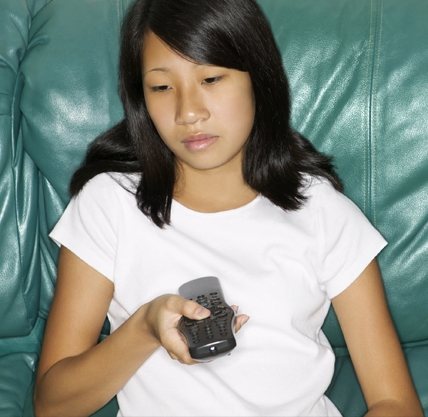
My teenaged daughter sustained a brain injury in a car accident more than a year ago. Now she has no motivation and wants to sleep or sit in front of the television all day. What can I do to get her up and more involved?
Your daughter's lack of motivation may stem from a number of factors. One, she is a teenager — not the most motivated developmental age group. But after a brain injury these tendencies may be drastically exacerbated.
A second factor is that she is likely recognizing that she is not able to do some of the things she used to enjoy at the level that she use to enjoy them, and is feeling a lack of confidence in her ability to do them at all. Teens are particularly loathe to stand out from the crowd for making a mistake, and your daughter may be avoiding participation in activities in order to avoid embarrassment.
A third factor to consider is that she may feel overwhelmed by activities more complex than sitting in front of the television, and may not have developed effective strategies to manage situations which she finds overwhelming. So, for example, the prospect of getting involved again with band may be too overwhelming for her to contemplate, but practicing her flute for 10-15 minutes a day might be more manageable.
Finally, your daughter's apparent lack of motivation may be a function of the brain injury itself. Parts of the brain are responsible for alertness and initiation of activity. Frontal lobe involvement may make it difficult for her to engage in activities even if she has a desire to do so. Diffuse axonal injury may induce a level of physical and cognitive fatigue even with what may appear to be a simple activity. A neuropsychological assessment will be able to determine which of these factors are having an impact on your daughter. She may benefit from some cognitive rehabilitation to help her to be better able to initiate and manage a more active lifestyle. Some counseling with a therapist who is familiar with the effects of brain injury in adolescents should also provide some support and strategies to rebuild her self-confidence.
You can help her look at some of the activities she used to enjoy or may be interested in and talk about ways to break them down into more manageable units.
Enlist the assistance of her friends. Look for a mechanism to help them to understand your daughter's brain injury, so that they can provide support and a sense of security for her. Many friends back away because they do not know how to react; engage them in the recovery process and they will be more likely to stick around.
About the author: Celeste Campbell, PsyD
Dr. Celeste Campbell is a neuropsychologist in the Polytrauma Program at the Washington, DC Veterans Administration Medical Center. She has a long history of providing cognitive psychotherapy and developing residential behavioral management programs for children and adults.

Comments (20)
Please remember, we are not able to give medical or legal advice. If you have medical concerns, please consult your doctor. All posted comments are the views and opinions of the poster only.
Bethany’s Mom replied on Permalink
People who have had a brain injury need sleep! The brain heals during sleep! DON’T EVER suggest that she is lazy. Try to establish a schedule. Get her up at the same time every morning, encourage personal hygiene, get her out of the house every day. Go for a walk together. My daughter likes to go to the gym, or swim at the YMCA. Back home, play a game WITH her so you can help her, drop hints, encourage her. A card game or word games like boggle, upwords or scrabble are good. If the games frustrate her, get the “junior” version of the game. Suggest that she rest after lunch, but not all afternoon! Perhaps she can help prepare supper, or encourage activity that stimulates brain activity, such as word search books, or puzzles. Adult coloring books are very popular. Get her into the habit of going to bed at the same time every night, say 9:00pm bedtime. People who have had a TBI work VERY HARD to perform routine day to day activities that we take for granted. Everything is harder, takes longer and exhausts them mentally and physically. I’m guessing by now most of her friends have moved on. She may be grieving the loss of those friendships. Give her time. She’s not the same person she was before the accident and, sadly, she never will be. She may be depressed at this realization, so seek help if you think that is the case. In the mean time, try to find something that sparks her interest and go with it. Good luck mom, you got this!
Anonymous replied on Permalink
My sister got a TBI 7 years ago from a motorcycle accident. She was told she would be a vegetable. She has learned to work, drive...again. She now lives with my little brother. Everything turns into a fight. She does not help around the house or cook. My brother writes all her bills. Why can't they just get along???
Kaper replied on Permalink
It's not just motivation. It's that spark of getting you moving that is lacking. Very difficult to go from sitting to doing. When my TBI first happened you could have told me the house was on fire and it felt as though that wouldn't have made me move. I would've been like "Oh. That's too bad...." Often times it is also my fear of "losing it" that keeps me from things. I've said and sobbed/screamed some things as well as gotten out there and felt like I just couldn't handle being out there at that time. My heart pounds and I start to freak. Other times I feel like my head just can't comprehend quickly and accurately enough all that is going on. What is so important, to me anyway is to be understood and to have help available. This is a scary situation.
Anonymous replied on Permalink
Hey How are you? So I have a 16 yr old TBI PT. I am very close with the family. I am a behavioral tech, paramedic and have had two TBI's myself. I worked so hard to get where I am today. But how would I motivate her? what forces will help her understand the nature of what is going on? She does the same thing as you just stated. "I don't care"
Mary G replied on Permalink
Thank you all for your honest and insightful contributions. I am 9 years out from my TBI and have experienced many varied symptoms . Although much of my previous self has returned lol I am still dealing with the mental and physical fatigue, lack of motivation and many incidences of depression. So far I've tried almost all that which I read here with little permanent change. But I am very glad to here that What I am still experiencing and struggling with is not abnormal and I am not imagining it and most importantly I am not just a lazy slug. As all of you I continue to search and continue to hope that those around me beleive in me support me understand and have compassion. Thank you
John l. barrella replied on Permalink
Head injury is very individualized and would require appropriate assistance. She would have to be given neuropsych. testing. Lots of neurosych. testing, since the brain is so complex, understanding the injuries will also need proper methods. She would need, not a clinical psychologist, not a psychiatrist, but a neuropsychologist, aware of potential head injuries, and aware of the treatments she will require. The treatments do exist, and they are basically the same for all. Cognitive remediation can undertake this situation, and any other head injured situation, and allow the treatments...(post the neuropsych. testing) to slowly allow her to come face to face with the injured parts of her brain. If done appropriately, this will take a little time, because it will be her "cognitive exercises to bring out those deficits". They may be very few, they may be more extensive, depending on the location of the injuries. But no matter where, they can effectively be brought out by "her"...as she undertakes the cognitive classes. While they are slowly dragged out she will already begin placing in her new memory "cognitive compensation techniques". This will take as long as it takes, but the time will come when her poster detailing her cognitive setting will have doubled, and as scary as that may seem, she will slowly realize how lucky she is in having been able to recognize her injuries. Friends come and go, so whether she is head injured or not, friendships are not forever. She may become sad recognizing her injury to the point of not recognizing how lucky she has been in having been given the proper assistance. First, and foremost, neurosych. testing. A neuropsychologist aware of these injuries, who will work with the cognitive remediation doctors and discuss her situation from time to time to see when she is finished with the treatments. Also further testing, even though she is young, and her work market not really in front of her yet, she will need to understand her injuries so she will be able to adapt in the future...good luck...
Mary replied on Permalink
Get her HBOT treatments. I’ve had them for multiple brain injuries. They work. HBOT.com
Janet replied on Permalink
My daughter had a serious brain injury 7 years ago exactly, she was 21 and just graduated , we run a local headway and found their support invaluable for myself and rachel , also psychologists at the brain injury unit they discussed problem and explained why,, it is hard as a parent to deal with ,but we had an activity planned every day , rachel then did voluntary work ,went to gym and returned to college ,she has just this year got a permanent job in admin ,it has been a very ling hard road ,none of her freinds stuck by her but she has achieved so much more that the prognosis ,it takes time unfortunately ,a lot of effort from others to get the right motivation,rachel is not the same girl as she was but adjusted to her different life and still here
JZ replied on Permalink
Thank you for all of the reassuring comments. I struggle with motivation every day and for the most part I can get through the noisy day. It takes its toll quickly though. After reading these stories, I don't feel alone with how I feel and I don't need to feel inadequate. But I do. I have heard many of the comments a lot of us have heard like "You look fine" and "Maybe you're using your TBI as a crutch" - that one is particularly cruel coming from anyone who has not experienced a TBI. It's been 2 1/2 years since my fall and resulting TBI and I get frustrated by feelings of inadequacy and not "feeling" right anymore. I just cannot explain how it feels and that does not help at all. I am blessed with a loving and supportive wife along with my children and few good friends. Let's keep moving forward in our recovery!
Jan Barker replied on Permalink
My daughter had a severe TBI 21 years ago, but still has issues...at the end of a busy day, she is quite fatigued, and even a simple task seems like too much work, or even the anticipation of a simple task. Sometimes it helps to break down the task into simple parts; just doing one part is often not so overwhelming!
Anonymous replied on Permalink
I had TBI, frontal lobe, 30 years ago. I have terrible trouble getting motivated and staying motivated. One thing that helps (sometimes) is turning off the TV and using a timer. Then I get bored. But I "try" to use it as a reward. 1/2 hour of cleaning (which I hate) and a 15 minute reward of TV. Still trying to perfect this system though. 😇
Laura replied on Permalink
Excellent article. I gave these issues as an adult with TBI. I had not looked at it from the retraining angle before.
Anonymous replied on Permalink
It stinks when you're no longer the capable person you were pre-tbi, and for a teenager that has to be especially hard. No doubt you already do a good job empathizing with her. Maybe try expanding from empathy to celebration of even the small things she's doing. Give her a genuine compliment whenever she accomplishes even the tiniest thing that takes focus, or organization, or planning, or extended effort - or any of the things she used to be able to do so easily. Maybe keep a little diary (a scratchpad would do) to jot down a word or two about what you saw her do that was worth a compliment. Then maybe once a week or every few weeks, take a look at that scratch pad & see what she's done. Share it with her so she can see she's making progress. Does she use facebook? Maybe suggest she connect with a brain injury group that way - folks who know what it's like to walk a mile in her shoes. It'll take time and effort and patience and help and enthusiasm, and maybe especially new tips & tricks to do familiar tasks. She needs you to believe in her to help her believe in herself again, and she needs you to be genuine - no fake happy faces. Best of luck for both of you.
Anonymous replied on Permalink
Yes, try & do nice things maybe go to countryside or park. Relaxing activities. I have had multiple PCS/tbi & trauma. It is winter & feel even less motivated now. The GP shouted at me & minimises & denies tbi which I know it is. It takes time to heal.
Anonymous replied on Permalink
Having had a severe Brain Injury myself I know how she is feeling. Her brain is working but ever so slowly and thinking and responding to people is very difficult. You need to allow her to relax. Watch her closely and offer her things she liked before the brain injury. Life is ever so different. Nothing is easy but you don't have any connection with reality as the rest of the family and friends do around you. Be there for her. Keep it simple. Don't change routines or she will become more frustrated. Put things back where they were so she can find them. Having to lay around is a way of coping the best way you can. In time she will start to get it together. In the meantime walk at her speed and don't expect the old daughter responses. Some challenging activities can be introduced like buying a carton of milk at the shop. I can remember going across the road to buy 3 things and having to come back 5 times to ask again what they were. Then My wife gave me the list. That worked.
Anonymous replied on Permalink
Most of what I wanted to say has been said by these other contributors. Well said!
I haven't lost any of my motivation, but I am frustrated daily with how mental fatigue over activities as simple as making a "to do" list can wipe me out to the point that I see flashing lights, get completely thrown off-topic by the simplest interruption (which most people would not consider significant enough to count as an interruption). I frequently take what I intend to be a half-hour nap around 10:00 am, fully expecting and desiring to get back to the project I started, only to wake at 4:00 pm with no more mental energy than when I got up in the morning. Then, if I hear a comment about lacking motivation on top of the frustration I have already endured, the emotional pressure builds to a point that I have to leave an take a nap or risk loosing control, and shouting nonsense in a state of rage.
I haven't done that in a long time, because after much discussion, my family understands the need to let me rest when I need rest. But even though my family understands, I don't really understand, and I deal with a lot of false guilt over the things I don't do that I so strongly want to do.
Anonymous replied on Permalink
Thank you for pointing out that apparent lack of motivation does not mean the same thing in a TBI survivor than it would otherwise. When every step of every decision requires filtering of dozens of related, but ultimately inapplicable ideas, a person with very high internal motivation can come across to others as distant, and uninterested. There may also be some depression involved in understanding that some former abilities may never be regained, but we all have abilities we never explored, and for every lost ability, a previously neglected ability may take its place. Long term, there is plenty of cause for hope. Another reason not to be too quick with a diagnosis of depression is that an injured brain can be loosing neurons due to excessive levels of neurotransmitters released by dying neurons, in a cascade that could be exacerbated with antidepressants. Rest, and careful monitoring of the balance of inflammation may be the best approach during the first two years after an injury. Too much inflammation may cause more neurons to die, but too little inflammation may prevent healing.
HȦnell, A. (2011). Plasticity and Inflammation following Traumatic Brain Injury. Uppsala: Acta Universitatis Upsaliensis.
Morganti-Kossmann, M. C., Rancan, M., Stahel, P. F., & Kossmann, T. (2002). Inflammatory response in acute traumatic brain injury: a double-edged sword. Current Opinion in Critical Care, 8(2).
Liz replied on Permalink
My dad is 66 years old. Suffered TBI due to his fast heart rate. He fell on the street. Long story short, we are 6 months in after having to go though 2 brain surgeries and a pacemaker, he continues to be in the skilled nursing. No progress yet. On top of all the frustration with his progress, last week he suffered his first seizure. Back to square one.
He has no motivation whatsoever. But we keep pushing him and pushing him everyday, same exact thing. He is sleepy and drowsy and not interested in anything at all. Before his TBI he was getting ready to travel. We can’t even motivate him to stand up or exercise so he can travel.
I don’t think TBI patients even understand what their likes or dislikes are. We tell my dad, let’s get you walking so you can travel the world like you used want, he is simply not interested or lacks comprehension or the desire. I hope I am not alone. I really want to know if he’ll ever walk again, and be himself ever.
Anonymous replied on Permalink
DAVID S. replied on Permalink
Thank you greatly for posting this & saying things in the way you have. I AM A LIFETIME SURVIVOR OF MANY TBI/ABI INJURIES ALONG WITH OTHER SYMPTONS & ISSUES. I need an occasional it is ok to be the way I am, all things considered I may look ok, this doesn't always mean that I am. I SHOULDNT BE HERE FOR THE MANY THINGS I HAVE ENDURED, FROM BIRTH TO NOW. BUT I AM
Thanks again