

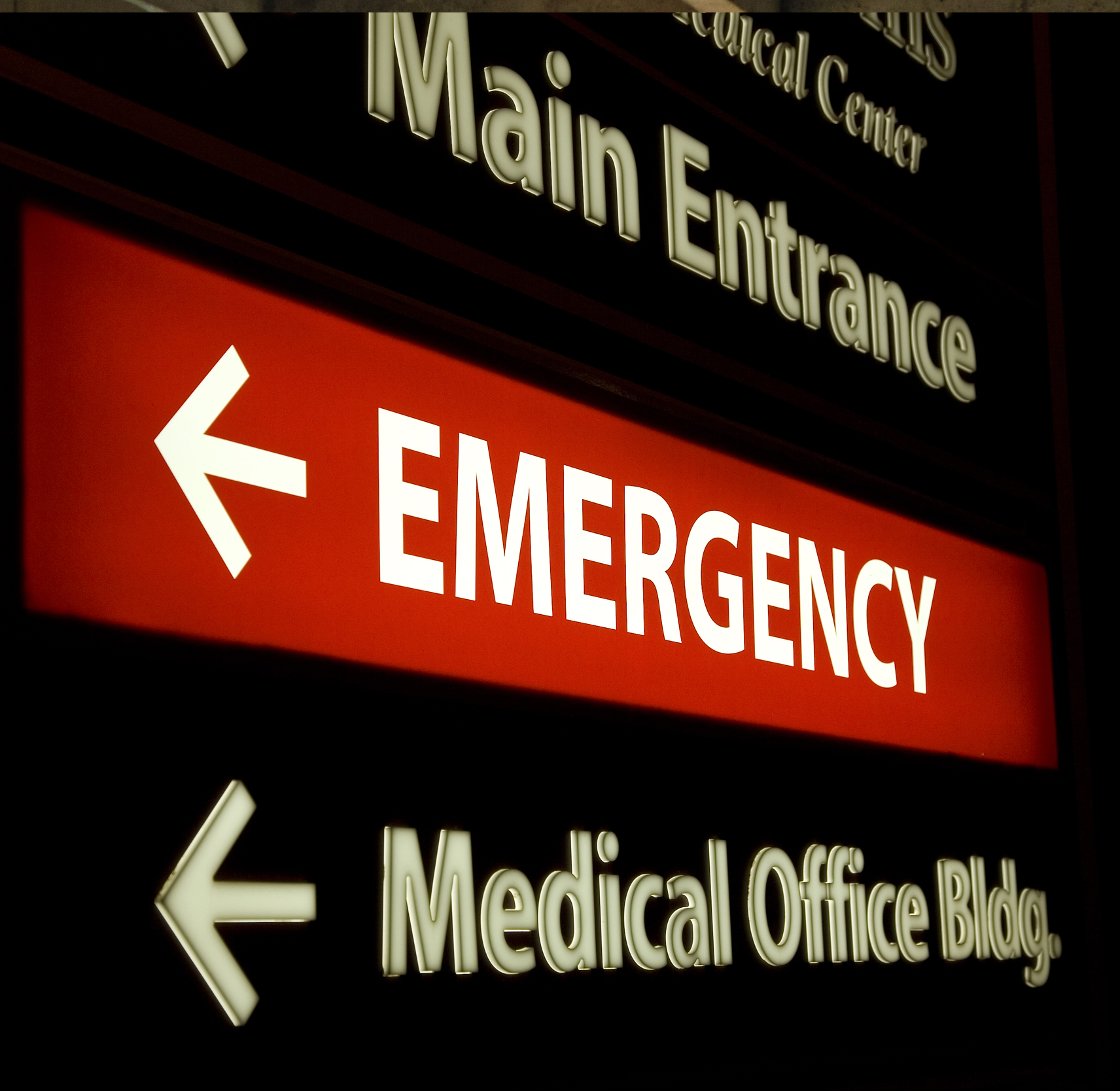
People who've just had their brains jostled may be in no condition to decide if they need medical care. And the people around them may not know that hitting your head can be dangerous even if you don't lose consciousness. How do you know when you should go to the hospital after having "your bell rung"?
Going to the hospital after a head injury can mean the difference between life and death. But how do you know when to go? This can seem like a difficult decision, but let me sum up the answer for you:
When in doubt, go to the hospital.
Not later. Not tomorrow. Now!
Here's why.
The hospital is the only place that has a CAT scanner that can "look" inside your head and determine if there is any bleeding in your brain. Bleeding in the brain can be life-threatening when there is enough blood in the right spot to press down on the brain and squeeze it. These dangerous forms of bleeding are called epidural and subdural hematomas. Because the brain is trapped inside the skull, slow bleeding can force important parts of the brain against the inside of the skull and through the small hole in the base of the skull called the foramen magnum. These important brain areas, which control breathing and heart rate, stop working when they get squeezed and this is what results in death. With a CAT scan, epidural and subdural hematomas are easily diagnosed. The treatment requires surgery to remove the blood clot. The quicker the surgery, the better the chances for a good outcome.
So, how do you know when to go to the hospital? The decision is easy if you're the one making it for someone else and that person is not responding to you or looks asleep. This is called coma. The risk of a subdural or epidural hematoma in comatose head injured patients is high and you should summon an ambulance immediately!
But what if the head injury doesn't cause a coma? What if the head injury just causes a brief loss of consciousness, brief period of amnesia, or a sensation of feeling dazed? A person who has such an injury — termed concussion or mild traumatic brain injury — can look, and even feel, just fine. The problem is, even though the person looks good on the outside, inside the skull there is a small chance that slow bleeding is taking place. After a concussion, the chances of this happening are not large — about 1 in 1000 — but the only way to diagnose it is with that hospital-based CAT scan.
Here are the symptoms of a concussion that should prompt an immediate trip to the hospital or emergency department.
- Loss of consciousness, even if only briefly
- Any period of amnesia, or loss of memory for the event
- Feeling dazed or confused
- Headache
- Vomiting
- Seizure
- In addition, for children under 2 years of age, any scalp swelling or abnormality in the way they usually behave.
One word of caution: because any brain injury — even a concussion — has the potential to injure the brain, the brain-injured patient may lack the judgment to make an informed decision regarding whether or not to go to the hospital. Family and friends can be instrumental in helping the patient chose a course of action that is best for him or her. And when in doubt, go to the hospital!
When in doubt, go to the hospital!
Please remember, we are not able to give medical or legal advice. If you have medical concerns, please consult your doctor. All posted comments are the views and opinions of the poster only.
About the author: Jeffrey Bazarian, MD
Dr. Bazarian is an emergency physician with a strong research interest in traumatic brain injury. He is associate professor of Emergency Medicine, Neurology, and Neurosurgery at the Center for Neural Development and Disease, University of Rochester Medical Center.

Comments (905)
Please remember, we are not able to give medical or legal advice. If you have medical concerns, please consult your doctor. All posted comments are the views and opinions of the poster only.
Anonymous replied on Permalink
My husband hit his head on a glass lamp hard. He says it’s hard to concentrate.
Leah replied on Permalink
So my dad fell of a 4 wheeler yesterday and it’s rearranged his head it look like his head shape is a cone now he refused the ambulance and firefighters service but they said he needed to be seen because they can’t leave him like that so my dad was very confused after he hit his head he was yelling at me and my auntie when we tried to get him medical help it’s like he scared of the hospital
Anonymous replied on Permalink
I fell and hit the right back side of the back of my head with on a planter. I have a huge hematoma as big as my hand. My skin feels tight it’s so large and I have a headache. I cannot lay down do I need to go to the hospital?
Anonymous replied on Permalink
I fell off a swing and my left cheek hit the ground first, after that my head has been aching alot, should I be worried?
Anonymous replied on Permalink
My 13 and I were wrestling and I accidentally got kicked above my ear with his heel. This was last night at 10 pm. I had an odd reaction no loss of conscience but I couldn’t sleep. I didn’t vomit any thoughts? Im a 38 yr old female.
Anonymous replied on Permalink
My toddler threw an iPhone 11 Pro directly at my temple. It hurts. How do you know when a temple injury is serious?
Den replied on Permalink
Fell down snow cover steps. Hit back of head on edge of step.
Now seem to have a groove across back of head
Anonymous replied on Permalink
I had a similar issue with the iPhone at my temple, did you end up being okay?
Lisa M DeBoer replied on Permalink
When you get knocked out
Anonymous replied on Permalink
Yesterday I've bumped the top of my head on a board, I have pain going down to my left ear and nausea
Anonymous replied on Permalink
I tripped over a buckling regarding week ago. I landed flat face first and knocked my forehead hard. Since I have been having headaches that seem to get worse everyday. Should I be concerened?
Anonymous replied on Permalink
The other day I was jumped by four people and hit in the face with a maglite and my whole face and head was swollen now the swelling has gone down to my eye and I can hardly see out of my eye the swelling is so big I've had a headache and not much dizziness or vomiting but the swelling is really bad
Suzzy replied on Permalink
I had the same issue
Anonymous replied on Permalink
I hit my head really hard on brick wall and i have a permanent big goose egg 2 years later , should i be worried? when i went into the hospital after it happened they sedated me and didnt check my head.
Anonymous replied on Permalink
Today I fell backward and put a bump on my head as big as an egg !! I have no pain ! No confused nothing ! Should I go hospital ?
Anonymous replied on Permalink
If someone punched me on both sides of the head and it's been 12 hrs since then will I be ok??
Anonymous replied on Permalink
I somehow made a dolly whiplash and slam hardon my head, also caused a laceration of my head that thankfully didn’t needs stitches, but was pretty bloody at first.
anon replied on Permalink
about an hour ago my sister and i were play fighting and i tripped while running and hit my forehead really hard on hard tile. the pain was enough to make me cry and i couldnt get up by myself at first so my sister helped me inside. i have an ice pack on my head to bring down the bump but i feel dizzy. im alert and everything just a bit dazed and worried bc i had a little head injury not long ago so idk..
Patryk Sienkiewicz replied on Permalink
I fell from ice 1 maybe 1,5 meter down onto a big wooden 90 degree angle block. On my lower back a bit to the left on on my spine. Hurts a lot but i can move. Worried i may have internal bleeding but im not feeling nauseous or have blood anywhere
Anonymous replied on Permalink
I fell from ice 1 maybe 1,5 meter down onto a big wooden 90 degree angle block. On my lower back a bit to the left on on my spine. Hurts a lot but i can move. Worried i may have internal bleeding but im not feeling nauseous or have blood anywhere
Anonymous replied on Permalink
I’m not sure if anyone is going to read this or not or if anyone can even give me some advice. I’ve been having heart palpitations and a sense of dizziness and confusion for a few weeks now. I can’t go to the doctor beacuse my insurance doesn’t kick in until next month and my local er isn’t doing ct scans right now super packed 24/7 beacuse of covid. I’ve been freaking myself out reading all of these articles and even scared to go to sleep, but it feels like i’m always tired and after I wake up I feel better. I went to the er a few months ago for chest pains and he said there’s a very low chance of heart attack or stroke happening. Im not sure what to do im just really afraid of passing out or something bad happening to me.
Anonymous replied on Permalink
I don't know if you got better, but I hope you're doing well.
Christina replied on Permalink
Hello, just red your comment and hope your feeling better, I, too, have the same symptoms and don't know what to do. On top of all that, I just stood up and passed out for a second or two, hit my Head and heard a crunch but don't feel much different than before, should I go to emergency room ???
Marilyn replied on Permalink
I’ve heard that hospitals do have funds to cover expenses when a person doesn’t have insurance. Try a different hospital also.
Anonymous replied on Permalink
i passed out yesterday and hit my forehead on a wall. there is no bump but it feels slightly raised and very sore to touch. i didn't get the chance to put an ice pack on it yet. is it something to be worried about...
Anonymous replied on Permalink
I fell 12 days ago and hit my head, hard. I received a huge bump (still have a small bump) on the back of my head, my neck was/is still hurting/ sore. And I am having headaches, everyday. Because it has been 12 days should I still go to the Doctors or emergency to have it checked out?
Lesa replied on Permalink
Yes, absolutely get a medical evaluation.
Anonymous replied on Permalink
Sometimes my head hurts in spots and I have weird things happen all of a sudden like the burnt smell and I remember someone saying that’s something to do with medical so I thought I should look it up, I also wonder if my forgetfulness is going to ever stop, and it will return back to normal, and I link the numbness of my right leg to my sciatica nerve that’s been damaged and I have severe tension upside my skull that radiates to frontal lobe on left side of my brain where it feels as a knot is there but I have no knot it’s just very sensitive.
Anonymous replied on Permalink
I feel over a banister and landed on my back and hit the back of my hard like it felt like it was split and sounded like a bomb.. I was afair5to touch my head but did and no blood..head hurts and I feel a little out of it..head in a cloud after 2 days kinda cant describ the feeling..should I go in to get extra..plus ribs hurt..
Anonymous replied on Permalink
I heard some shocking news from my husband when were in mall in a queue, and i started feeling weird like i want to sit down or lie down..but there was no chairs around so i went to a place whee no one was around leaned back to it but i dont know when i passed out. next thing i know is my husband is next to me asking are you ok?I woke up n walked to a table and sat down when my neck hurted badly..i got some water and ice packs!we dint go to ER ,we went home. next day i went to urgent care.Doc said if you have severe headache, confusion,light headedness go to ER so i am still wondering if catscan would hep. Iam worried now. my right side of head is bit painful and swollen , my neck hurts.i have been icing but i am worried
Anonymous replied on Permalink
Good information to know I feel better now that I know more about my injury
Anonymous replied on Permalink
Ok, so my boyfriend is constantly hitting himself in his head and face with hard heavy items as well as closed fists. Been doing it for a long time like years. He gets swelling and bruising time to time, even popped blood vessels in his own eye. Now he's got some severe swelling just above his right temple and says it feels like he's getting an ear infection and uncomfortable pulsing if leaning over along with migraine that favors the side that's swollen all the way down into his jaw by his ear. Should I be more concerned about this swelling than previous swelling he's caused himself before that would just go away over time? Or is this swelling more severe considering the location?
Savanna Temple replied on Permalink
I'd be concerned that he's hitting himself in the face in the first place. He must have done kind of brain damage or pressure or even growth on his brain causing this behavior.
Anonymous replied on Permalink
i hit my head on a wall i had a headache going away theres a bump its red and a scratch not gonna lie reading this scared me
Yikes replied on Permalink
I think you should get out of that unhealthy and toxic relationship. He hits himself with closed fists? Wtf? He needs he’ll and if you stay, you do too.
Anonymous replied on Permalink
i hit my head in metal and I feel dizzy should i go to the docter
Anonymous replied on Permalink
I hit my head last Sunday. The area hit tingles. Sometimes I feel it on another area of my head. Is this a blood leak
I didn't pass out.
Anonymous replied on Permalink
I had a heavy metal bed frame fall on my head today. My head has a gooseegg. Very tender. Should I go to hospital?
Anonymous replied on Permalink
10/15/21
I passed out and hit the back of my head. Went to ER. Cat scan was clear. But BP lower number dropped to 40.
I went home
Now a week later the spot still throbs and I have a slight headache at times. What do I do now?
Cora replied on Permalink
I fell on concrete and head,back,kneck hurting
Anonymous replied on Permalink
I hit my head when i feel upset but now there's a bump on my head for 2 weeks and its pink, i get headaches often since then
Jeffrey Hauk replied on Permalink
I was rearranging my garage I had a suspended bicycle girls Junior bicycle hanging upside down in the rafters on hooks it was about a foot and a half drop it drop it fell onto my head the top of my head my top my head has a small laceration about the size of a K looks like a K it’s continuously bleeding snap that much I would say maybe about a very small paint sample size like a model paint bottle size in about an hour maybe if that means it’s it’s slow down but it just won’t stop bleeding it’s been about 4 1/2 hours now I am just curious what should I do
Ashley replied on Permalink
Depending on the location you could have possibly damaged an artery in your scalp if so you will need medical attention
Candy replied on Permalink
I was using a electric drill screw driver to put a peace of wood in my cabinet to put a shelf on and I slipped and the wood flew off the drill and hit me on my right side on my forehead above my eye I take blood thinners and I brush very easy but it did not brush it is very sore should be worried
Misty mitchell replied on Permalink
My ex and I had got into it and he hit me in my face with his pistol and I have had a headache ever since and that was 13 days ago . I dont have insurance and I'm scared something is wrong
Anonymous replied on Permalink
I was in a little store, 42 hours ago. I didn’t realize there was a step to get out of the store. I tripped and hit my head on an antique hard wood door. I remember the sound it made but don’t remember anything thing that happened after I heard the sound of my head hitting. Next thing I know I’m up and people are dusting me off. I was very confused as I was picking up the things I had bought. My husband who was outside and 2 small shops from where I fell heard the sound of my head hitting the antique hard wood door I have a bad headache, no bumps but my whole right side of my body hurts. Especially my shoulder where the ball socket is and my elbow. I broke my elbow 5 months ago and it feels like I may of fractured it again. Should I seek medical attention?
Anonymous replied on Permalink
Do you think something is damaged from inside if being hit hard on head and then pulled hair so hard a few times and your head is hurting alot like it's bleeding
Tiffany Harris replied on Permalink
I am on Xarelto, last night I slipped on mud and hit the concrete hard, no head injury, but I am unable to bend my knee and now the left side of my abdomen where I hit is slightly swollen and feeling pain and nausea, should I be worried?
Tony replied on Permalink
Yes go to ER
Anonymous replied on Permalink
I fell backwards from a bench bruising my bottom badly and banging the back of my head on a concrete floor. My head is slightly painful to touch. 3 days later I went over on my ankle and fell to the ground again. Head tender to touch, neck tender to touch. Do I need to go to A&E.
Pages