

My loved one has hearing loss due to a TBI. Are there any suggestions you have to help her feel more connected with family and friends?
Hearing loss can sometimes occur with TBI. This can be the result of damage to the tiny bones in the middle ear or a fracture of the inner ear or cochlea. Even if the hearing in the ear itself is not damaged, a person with TBI can have a loss in hearing that is caused by the way sound is processed in the brain.
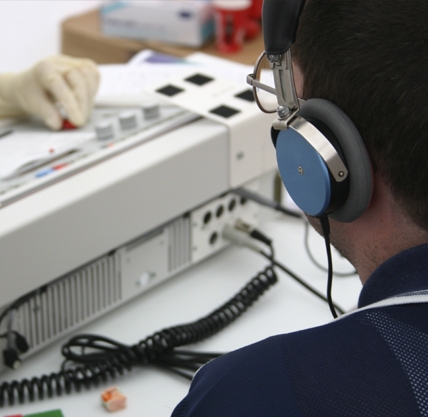
Hearing problems can be very frustrating and isolating. If your loved one has not already done so, she should be seen by an audiologist for a complete hearing test. The results of the hearing test will help determine the most appropriate treatment. Treatment may include medical management, hearing aids, or auditory processing therapy. It's important to determine how much of the hearing loss is caused by other symptoms such as memory or attention difficulties, which may also accompany a TBI.
Here are some other suggestions to help make your loved one feel more connected to family and friends:
- Turn down background noise such as the TV or music. Noise can make soft sounds harder for your loved one to hear and will make speech unclear and difficult to understand.
- Have a conversation with only one or two people at a time, and sit or stand close when talking. Moving closer to your loved one will increase the volume of your voice and will make it easier for her to hear and understand what you are saying.
- Get her attention before talking — tap her shoulder or place your hand on hers. Make sure you are facing her so that she can use your facial expressions and lip movements to help fill in any missing information.
- Your loved one should ask her audiologist about assistive devices such as a frequency-modulated (FM) systems or a less expensive hardwired system. A wireless FM system would allow her to hear you from across the room as though you are speaking directly into her ear. Assistive devices increase the volume of the speaker voice, while decreasing the interfering background noise.
About the author: Janet Brown, MA, CCC-SLP
Janet Brown, MA, CCC-SLP spent twenty years in practice at the Veterans Administration Medical Center and at the National Rehabilitation Hospital in Washington, DC. She is the former director of Health Care Services at the American Speech-Language-Hearing Association.

Comments (26)
Please remember, we are not able to give medical or legal advice. If you have medical concerns, please consult your doctor. All posted comments are the views and opinions of the poster only.
Anonymous replied on Permalink
I am a 65yo male who was born with a hearing deficit.2 years ago I suffered a TBI.I was declared incompetent and life has been a nightmare.I can't use my traditional hearing aids because they worsen my post TBI headaches.My hearing was worsened by the accident and unfortunately it's not been recognized as a problem until recently and only by myself.I'm currently working my way through this but appreciate the confirmation of my opinion.
Thank You!!!
Håkan Ask Morling replied on Permalink
Hi, I have had a head injury, was in coma for 2 weeks almost died twice at the hospital and having devoted all my life to sound tech and music I ended up with one crazy ear. No low or high frequencies at all. But in the mid as the sound passes a threshold of loudness - not so loud, but about low voice sound, the sound suddenly decides to be heard by the ears systems. But the sound is distorted, almost like digital bit distortion at times and like a badly scratched CD sometimes and with the pre-amps turned up to full volume overdrive. Like the speaker cone has been torn and the edges flapping. The best audio is when using headphones at a certain level, but stereoeffects are hard to notice, but the base and keyboards sound better in the middle and the undamaged ear helps with frequency inrerception. But outside and in real life sound directions are coming from all the wrong places so that parts gone, and working as a sound technician is out of the question, but sometimes i think that maybe the doing, listening and using the ear, forcing it to action may just be the way to make it heal, or is that maybe the oposite? Should I be careful and not use the ear for some years letting it heal with a plug constantly covering the ear instead? All the best and all my best wishes for you I've read about here with similar problems. And musicians, just remember. We just can´t quit, but we can change our ways of keeping music in our life. Wasn't it Beethoven that was all deaf?
Andrew replied on Permalink
I have found that t he sudden increase in volume is a warning sign of a seizure. It has happened twice to me and they were grand Mals. Both ending up in hospital. When you have a TBI ‘contra coup’ bouncing of your brain in skull can damage the small bones for hearing.
Jeff Cann replied on Permalink
Hi Janet,
I realize this is an old post. Hopefully you're still moderating comments. I had a serious TBI in 1995. I don't think at that point anyone was talking about the long term impact of TBI (at least not to me). I've been in a hearing loss slide for over a decade. Unsure if it's accident related. My father has poor hearing too, but mine became a problem at about 45 y.o. It has either accelerated or hit the point where it is so noticeable that I can't ignore it. I've been wearing hearing aids for three years and while they help me hear the sounds, I often have trouble understanding what's been said. Fast talking, muffled talking, poorly amplified talking... I can't understand any of it. On a side note, my relationships have been deteriorating since the accident to the point now where i don't really have friendships other than my immediate family. Could you please direct me to some literature that might help me better understand what's going on?
Jeff replied on Permalink
I am deaf in my left ear due to TBI in a car wreck. If I get a hearing aid that puts the sound from my left side over to my right ear, would it help my balance?
Ryan replied on Permalink
Hi. I had a TBI in 07 and lost 98% in my left ear and 40% in my right. All I've been told is that it's a brain thing. My ears are fine, showing great vibration in both and sounds are going in fine. Our brain cannot interpret the sounds properly and therefore leaves tinnitus. To me that is the worst because half my hearing is a 10000 crickets going a million miles an hour and with any background noise, it is impossible to grasp. I don't even bother with the tv and glad I play bass, not guitar.
Becky replied on Permalink
I lost a lot of hearing in my right ear, mainly the high frequencies, after TBI, coupled with tinnitus, and had hyperacusis in my left ear. This was from splitting my head open on the corner edge of bricks.
Hearing aids retrained my brain to practically block out the tinnitus and get rid of most of the hyperacusis.
Then I fell again 15 mos later and lost hearing in the lower frequencies in the same ear. I had a sensorineural concussion with no broken bones, no loss of balance, etc.
I had researched that hyperbaric oxygen treatment will bring about a lot of healing. 2 months after the 2nd accident, I had quit smoking for over a month and gained significant healing in all frequencies. Smoking takes out your oxygen level.
I look forward to more healing as my body receives more oxygen. (Any one who smokes cannot use a hyperbaric oxygen unit, as you outgas and it would ruin the chamber) I intend to use one after having quit for five months. (minimum requirement)
Anonymous replied on Permalink
Jeff, I suffered a traumatic brain injury in 2011 that caused complete deafness in my left ear. I have hearing aides called CROS. I have a hearing aid in my deaf ear that puts the sound from the left side of my body into my right ear's hearing aide. It took a year to get used to my new normal. Now, I prefer to have them on--not off. Also, I have balance problems to this day. I try to cope with it-the room moves in ways it shouldn't when I move my head. Walking in the dark really puts me off balance. You might want to get an audiologist or chiropractor how to do the Eply Maneuver. Hope this helps!
Anonymous replied on Permalink
I suffered a TBI almost 6 years ago, and lost my hearing on the left ear completely and also suffer from tinnitus from both ears as well. I don't know if this will get any better, but I'm not going to lie, I feel abandoned as no one wants to talk to me.
LLH replied on Permalink
I suffered a TBI nearly 3 years ago myself. I have hearing loss and hearing "distortion" due to the TBI. All voices are distorted, my brain can't promise music among other things. I've now gotten to the point in my recovery where I feel I can focus on trying to figure out my hearing. That's why I'm starting to look at sites like this and I saw your comment. I know your comment is a few months old. Hopefully you are in a more hopeful place now. But I just wanted to send you a message in the great beyond that is cyber space and let you know that you're not alone. I feel angry and helpless and like no one understands too (often). Currently I'm trying to find some outlets for that. Right now I'm writing about it and trying my hand at research. I hope you're OK Anonymous. I'll be thinking of you.
J replied on Permalink
Dear Anonymous,
I found this webpage and your comment while doing research about hearing loss due to TBI. I am not the one who had the injury I’m a family member trying to understand what my mom is going through.
I just wanted to say your comment really touched me and I hope that since you posted it you no longer feel abandoned or alone. I would never want my mom to feel like that though I’m sure some days she probably does. I’m sure your family and/or friends don’t want you to feel like that either and I hope they will be better at reaching out to you and showing you kindness and care.
I don’t know you but I just felt like I had to say that.
Wishing you hope, even though my mom’s hearing loss is considered permanent and is currently continuing to deteriorate we have hope that it won’t always be that way and that’s what is getting us through. Take care!!
Carrie Huffman replied on Permalink
I have hearing loss in both of my ears. I can't really hear anything unless I have my hearing aids in. I was in an abusive marriage and was hit in the back of the head too many times over the years. It is scary to lose something you've had your whole life and it is an adjustment, but you will be just fine!! Mine will not get any better it is permanent. But I am alive and thats what counts. best of luck to you!
Anonymous replied on Permalink
My son has had two brain surgeries for intractable seizures and three concussions with subarchnal hemorraging with in the past two and a half years. Thankfully the seizures are controlled with the latest surgery, completely separating the two halves of his brain. Today, as a follow up for a double ear infection, a hearing test revealed profound hearing loss in his left ear. Could this be a result of essentially having numerous brain injuries over these past 2+ years? Is it treatable? He also has autism and cognitive deficits from years of seizures and seizure meds.
Anonymous replied on Permalink
Thank you for this beautiful and courageous story. Blessings and continued healing.
Anonymous replied on Permalink
I'm 23 and had a severe car accident as an 8 year old child. I've had gradual hearing loss since that time but in May 2015 I had severe ear infections which caused the hearing loss to become complete and permanent. I'm now almost completely deaf. After seeing a different audiologist at every appointment the problem has still not been resolved and I am awaiting more tests to see if I have a processing problem. Fortunately I have been accepted to receive a hearing dog for the deaf, this will change my life and hopefully mean no more panic attacks while I'm at college or at work or even out shopping. Just keep fighting the fight and remember how strong we are to live in a silent world but still be part of it.
Anonymous replied on Permalink
I know exactly what you're talking about. I had a TBI some years back and lost the majority in my right. Can't pinpoint sound location either. I also am a musician and basically just turn it up. Constant tinnitus is an unwelcome bonus. I am so damn vain that a hearing aid is out and am considering x-rays to see if something is physically damaged or if a nerve got whacked. Sorry about your trauma and ongoing issue. Hope you're adjusting enough and at least we're still above ground. Oh, and Happy Thanksgiving.
Håkan Ask Morling replied on Permalink
Got thrown out of a bus, crushed my head right side and ended up with what you're describing above. I am also a musician and well was an audio technician. can't really do that any more now, but how have your injury evolved since this comment in 2015?
All the best and hope you're better now.
/Håkan
Anonymous replied on Permalink
Hi, I'd like to say thanks so much to everyone who's kindly shared their experience here. It's been so helpful to read. I had a similar injury two weeks ago. I'm now struggling with what feels like deafness in my left ear, frustrating inability to decipher sounds clearly and hear the sound of my voice accurately. For the first time in my life I'm having to ask my family to turn and talk to me so that I can hear what they're saying, especially if other sounds are present.....e.g if the kettles boiling. I also find it frightening when home alone because I've always had brilliant hearing, and now I can't identify the source and location of sounds, everything sounds dulled and this is confusing if you're particularly trying to hear what a sound is or where it's coming from. Finally, I should add, I'm a musician, so I'm hugely concerned that this condition might be permanent. It would be impossible to stand up reliably all evening with a heavy instrument without the worry of head movement related dizziness which would no doubt send me whirling to the floor,apart from the effect on ability to sing, hear harmonies, or remember chord progressions and words. Everyone is very kind and keeps telling me that I'll be better soon, but it doesn't feel that way right now. Good luck with recovery and finding help to everyone who has contributed.......it's reassuring to find that I'm not alone. Wishing everyone long term solutions to their hearing issues.
Anonymous replied on Permalink
Since being head butted in the left eye and nose area of my face I have had vestibular issues, headaches, nausea on a daily basis and also tinitus with a loss in hearing ability. I find it extremely difficult to hear my wife or daughter especially if they are over 10 foot away from me or turned away from me when they speak. This has been an issue for almost 2 years in a couple of weeks. I am being treated by WC and they are not truly recognizing my issues. I had a sinus surgery, vestibular therapy, and nerve decompression and removal on the left side of my forehead and nose. Unfortunately nothing has improved with the exception of breathing better on left side once they removed the cartilage from my sinus area. Thinking I need some hearing aids, hoping they will help.
Anonymous replied on Permalink
Hi,I've lost my hearing on the left ear after suffering a TBI, (Tinitus included) I fell from 25 feet on a hard surface. I've had many injuries, lucky that I'm alive. I've suffered balance issues (VOR) vestibula ocular reflex. Can anyone guide me on how to fix the balance problems? As when I move my body or head everything moves in vision. Very frustrating, effecting my sporty life big time. Thanks
Anonymous replied on Permalink
Thank you for using empathy while answering the question. I am 29 years post TBI. I have not seen one person make any accommodations for me, it's always been me accommodations for others. Now I feel completely abandoned by my family, and I got labled with mental health disorder. Now I'm having a difficult time getting help for my health problems related to the brain damaged sustained from the TBI. Life is a horrible struggle. Then you add hearing difficulties into the mix, how can you have any social life if nobody wants to work with you? Leading to nothing but despair!
Anonymous replied on Permalink
Hearing change after a brain concussion may be a loss or something very subtle like acquired central auditory processing disorder (CAPD/APD) where only parts of sounds are processed. CAPD/APD is a fairly recently invented term which not everyone is aware of yet which does help explain some very subtle hearing glitches in some persons with brain concussions.
Robert Lozier replied on Permalink
A 71 year old responding here...A little over two weeks ago I collapsed for the first time striking carpeted concrete just over my right eye causing an enormous hematoma and black eyes. CAT scan says no fracture. Within days I noticed my perception of voices has changed. Everything is clear but voices seemed to have definitely shifted upwards to give a sort of nerdy 'Steve Urkel' twang to my perception of their speech. I am scheduled to see a neurologist but that is more than 10 weeks out! Maybe I ought to try using this term CAPD/APD in my comments...
Anonymous replied on Permalink
Saba replied on Permalink
My son also has hearing loss in right after TBI.
Anonymous replied on Permalink