

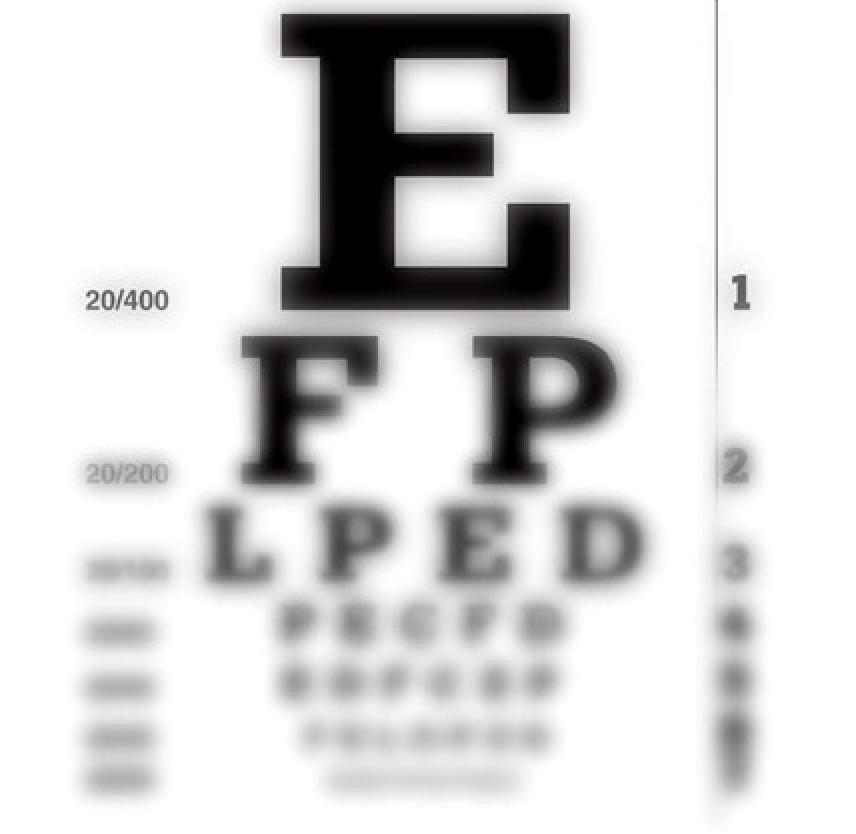
There is an extremely high incidence (greater than 50 percent) of visual and visual-cognitive disorders in neurologically impaired patients, such as those with traumatic brain injury. Read on to learn more specifics about vision issues and TBI.
More than just sight is measured in terms of visual acuity; vision is the process of deriving meaning from what is seen. It is a complex, learned and developed a set of functions that involve a multitude of skills. Research estimates that eighty to eighty-five percent of our perception, learning, cognition, and activities are mediated through vision.
The ultimate purpose of the visual process is to arrive at an appropriate motor, and/or cognitive response.
There is an extremely high incidence (greater than 50%) of visual and visual-cognitive disorders in neurologically impaired patients (traumatic brain injury, cerebral vascular accidents, multiple sclerosis etc.) Rosalind Gianutsos, Ph.D.
"Visual-perceptual dysfunction is one of the most common devastating residual impairments of head injury". Barbara Zoltan, M.A., O.T.R.
"The majority of individuals that recover from a traumatic brain injury will have binocular function difficulties in the form of strabismus, phoria, oculomotor dysfunction, convergence and accommodative abnormalities". William Padula, O.D.
The process of vision can be broken down into three general categories; 1) visual acuity and visual field, 2) visual motor abilities and 3) visual perception.
Visual Acuity and Visual Field
Visual Acuity - This refers to the clarity of sight. It is commonly measured using the Snellen chart and noted, for example, as 20/20, 20/50, 20/200 etc. Visual acuity becomes blurred in various refractive conditions, for example, myopia (nearsighted), hyperopia (far-sighted), astigmatism (mixed), and presbyopia (age-related loss of focusing).
Visual Field - This is the complete central and peripheral range, or paNORAma of vision. Various neurologic conditions, such as stroke, cause characteristic losses of the visual field, for example hemianopsia. The person may, or may not, concurrently demonstrate a visual neglect which is a perceptual loss of vision and visual motor integration to the side of the visual field loss.
Visual Motor Abilities
Alignment - This refers to eye posture. If the eyes are straight and aligned the eye posture is termed phoric. If an eye turns in, out, up or down compared to the other eye then the eyes are not straight or aligned and the condition is termed strabismus. Exotropia is a form of strabismus where an eye turns out, esotropia is where an eye turns in, hypertropia is where an eye turns up, and hypotropia is where an eye turns down. These can also occur in combination, such as hyper- exotropia, or hypo-esotropia.
- Fixation: The ability to steadily and accurately gaze at an object of regard. This is most dysfunctional in nystagmus which is an uncontrollable shaking of the eyes.
- Pursuits: The ability to smoothly and accurately track, or follow, a moving object.
- Saccades: The ability to quickly and accurately look, or scan, from one object to another.
- Accommodation: The ability to accurately focus on an object of regard, sustain that focusing of the eyes, and to change focusing when looking at different distances.
- Convergence: The ability to accurately aim the eyes at an object of regard and to track an object as it moves towards and away from the person.
- Binocularity: The integration of accommodation and convergence.
- Stereopsis: Depth perception.
Visual Perception
- Visual-Motor Integration: Eye-hand, eye-foot, and eye-body coordination.
- Visual-Auditory Integration: The ability to relate and associate what is seen and heard.
- Visual Memory: The ability to remember and recall information that is seen.
- Visual Closure: The ability "to fill in the gaps," or complete a visual picture based on seeing only some of the parts.
- Spatial Relationships: The ability to know "where I am" in relation to objects and space around me and to know where objects are in relation to one another.
- Figure-Ground Discrimination: The ability to discern form and object from background.
The Three Most Devastating and Intolerable Visual Problems Resulting From Brain Injury and Stroke
Although there are many visual problems that arise from brain injury and stroke, three are more devastating and impairing than the rest. These are visual field loss, intractable double vision, and visual / balance disorders.
1. Visual Field Loss
With a visual field loss the patient is literally blind to half of their field of vision. This places the person at increased risk of further injury and harm from bumping into objects, being struck by approaching objects, and falls.
A two-fold approach is used to treat visual field loss. Visual rehabilitation activities are prescribed by the doctor and administered by the therapist to teach scanning of the hemianopic field loss. This is a difficult task. It is the act of seeing something that brings our visual attention and scanning to bear. However, these patients do not see to the field they are being trained to scan and attend. Therapy is aimed at teaching that and several approaches have been developed to assist in this, but remediation still requires a lot of effort and patience.
Special visual field awareness prism lenses are used in treating visual field loss. As the patient scans into the prism the optics are shifted so as to perceptually gain about 15 to 20 degrees of visual field recognition. Since diplopia is perceived when scanning into the prism, fixation in the prism must be brief. These are used as spotting devices only to determine if there is an object in the periphery that deserves further visual attention. When such an object is spotted, the patient turns their head to view it in detail with their intact central vision.
2. Double Vision (Diplopia)
Double vision (diplopia) is a serious and intolerable condition that can be caused by strabismus, ophthalmoplegia, gaze palsy, and decompensated binocular skills in patients with brain injury, stroke, and other neurologically compromising conditions. Prisms, lenses and/or vision therapy can oftentimes help the patient achieve fusion (alignment of the eyes) and alleviate the diplopia. If and when these means are not employed, the patient may adapt by suppressing the vision of one eye to eliminate the diplopia. If lenses, prisms, and/or therapy are not successful and the patient does not suppress, intractable diplopia ensues.
In this population of patients, patching has frequently been used to eliminate the diplopia. Although patching is effective in eliminating diplopia it causes the patient to become monocular. Monocular, as opposed to binocular vision, will affect the individual primarily in two ways; absence of stereopsis and reduction of the peripheral field of vision. These limitations will directly cause problems in eye-hand coordination, depth judgments, orientation, balance, mobility, and activities of daily living such as playing sports, driving, climbing stairs, crossing the street, threading a needle etc.
A new method of treating diplopia that does not have these limitations has been successfully evaluated. It is called the "spot patch" (invented and named by this author) and is a method to eliminate intractable diplopia without compromising peripheral vision. It is a small, usually round or oval, patch made of dermacil tape, 3-M blurring film (or another such translucent tape). It is placed on the inside of the lenses of glasses and directly in the line of sight contributing to the diplopia. The diameter is generally about one centimeter, but will vary on the individual angular subtense required for the particular strabismus, or gaze palsy.
3. Visual Balance Disorders
Visual balance disorders can be caused by a Visual Midline Shift Syndrome (VMSS), oculomotor dysfunction in fixations, nystagmus, and disruptions of central and peripheral visual processing. A full description of these disorders is beyond the scope of this paper. The treatment will depend on the visual diagnosis and etiology. Lenses, prisms, and visual rehabilitation activities are used in the remediation of these disorders.
From NORA Neuro-Optometric Rehabilitation Association. Reprinted with permission. All rights reserved.
Comments (8)
Please remember, we are not able to give medical or legal advice. If you have medical concerns, please consult your doctor. All posted comments are the views and opinions of the poster only.
Scott R. Fox replied on Permalink
"Research estimates that eighty to eighty five percent of our perception, learning, cognition and activities are mediated through vision."
Please could I see the reference to support this information?
Scott Veenvliet replied on Permalink
NeuroRehabilitation 27 (2010) 215–216
DOI 10.3233/NRE-2010-0599
Courtney replied on Permalink
Looking into this, it seems that this statistic is attributed to/originates from
The Nora Organization: https://noravisionrehab.com/-vision-a-brain-injury
Perhaps you could try contacting them?
Jens replied on Permalink
This might get you closer: https://nora.memberclicks.net/vision-and-brain-injury ?
Anonymous replied on Permalink
to the comment above--^ If you go to a behavioral OD, you will realize they are in fact talking about what your asking.. Your just not familiar with the terms and how they apply to reading among 1000 processes you do daily. I'm in vision therapy after TBI- at 4D Vision Gym under Dr Juanita Collier.
Anonymous replied on Permalink
Hate to say it but a long as the draft consumes the nation this opportunity will apply.
My study shows that the soldiers returning will not want to incorporate the decisions from congress from the grateful nation...
Anonymous replied on Permalink
Anonymous replied on Permalink