

 Children with TBI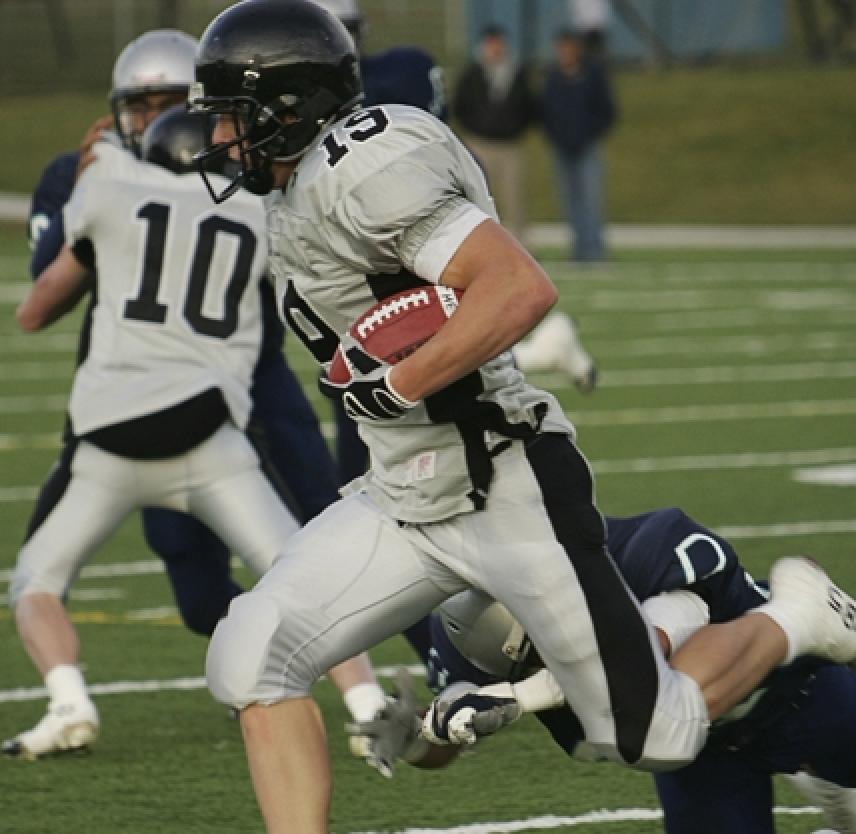
Chapter 1
Football’s Concussion Crisis
Here’s what terrifies me. Twelve-year-old Kyle Lippo, a seventh-grade football player from Round Lake, Illinois, during a game told his coach he had a headache and asked to sit the rest of the game out. Five minutes later, the coach asked Kyle if he wanted to go back in. Kyle said no, because his headache was getting worse. Then he started crying, saying, “It hurts really bad!”
Kyle was rushed to a local medical center, where he was loaded onto an emergency helicopter and taken to Advocate Lutheran General Hospital. There, on September 27, 2003, the Boy Scout, trombone player, and student council representative died from head trauma.
A few weeks later, Osten Gill, a 16-year-old high school sophomore from Rushford, New York, collapsed on the team bus as it was returning from a junior varsity football game. He had complained of dizziness and nausea after being hit during the game, and had vomited on the sidelines and on the bus. Osten died at a hospital several hours later.
Then in November of 2003, 17-year-old safety Edward Gomez drilled a wide receiver coming across the middle on fourth down, forcing a dropped pass. Gomez popped up, was congratulated by his teammates, and headed to the sideline. Moments later he lost consciousness and collapsed. He died days later.
Unlucky teenagers with isolated head injuries, you might say. After all, it is true that the number of deaths in youth football and youth sports in general caused by head injuries seems low, but I soon learned that death isn’t the only worry associated with brain trauma. I played football for Harvard, and I recently attended a black-tie dinner celebrating the 100th anniversary of Harvard Stadium—the nation’s oldest football stadium. Among the famous people at the event was former Chicago Bear great Dan Jiggetts, Harvard class of 1976. Every Chicago sports fan knows Dan from his playing days and broadcasting career, and, since he and I lived within a few miles of each other while I was growing up, he had taken an interest in my career. We chatted that night, and he asked how my wrestling career was going (it was 2003, and I was working for Vince McMahon and World Wrestling Entertainment—the WWE). When I told him that I had been sidelined with post-concussion syndrome, he became very serious. He told me, “You don’t want to mess with that. The players of my generation are all worried about the links they’ve found with Alzheimer’s disease.” This was the first I’d heard of that supposed link. I lost my appetite.
The more I looked into my concussion problem, the more I realized that I had never heard of any of the true dangers posed by head injuries. Nor had the rest of the United States, it seemed. Why? Because the organization with the most money to study concussions and the biggest stage from which to spread the message at this point hasn’t shown the ability to publicize the truth about these devastating injuries. To do so might hurt not only its game, but also the youth programs that feed its league and guarantee its loyal audience. Instead of promoting the proper information on safety, it uses its bully pulpit only to protect its business interests. The organization? The National Football League.
Curiously, my study of head injuries in youth and professional sports didn’t start while I was playing football for Harvard, but while I was working for the WWE. “Holy shit, kid! You okay?” was the first thing I heard after the kick to the head that led to the end of my wrestling career. The referee, Nick Patrick, leaned in, trying to figure out if I’d survived. Moments before, Bubba Ray Dudley’s boot had met my chin with enough force to make the Hartford Civic Center explode. Or that’s what it looked like to me as I lay on my back in the middle of the ring. Something was wrong with my vision. I didn’t know where I was, what was happening around me, or why I was staring up at fuzzy-looking lights on the distant ceiling of a gigantic arena— I only knew that something was terribly wrong. I looked to the side, and saw thousands of people staring back at me. I gazed back up at Nick. I didn’t want to move. My head felt like it was in a vice.
Then, a three-hundred-pound man with a crew cut and army fatigues appeared out of the fog—ready to squash me. I braced myself for the impact. Crash! My head hurt more. Instead of rolling off of me, he hooked my leg, and the referee started counting.
“One! Two!”
Why is he counting? Oh yeah, I’m in a wrestling match. But wrestling is fake, right? I should be safe, because this stuff is scripted.
But I can’t remember the script.
“Kick out, kid!” Nick whispered to me. I jerked the militant off me before the ref reached the count of three. I felt like a panicky little kid lost in a crowd. Slowly I started to remember what was happening. I’m in a tag-team match against the Dudley Boyz, my partner Rodney Mack is in my corner with our manager Theodore Long . . . But, before this crowd of thousands of pumped-up WWE fans, I still couldn’t answer the most important question: What comes next? I know I have to do something, but what?
I was able to finish the match against the Dudleys (I lost), and I stumbled backstage, lay down on the cold cement floor, and tried to compose myself. I was coherent and aware of my surroundings, but I couldn’t get past an odd, throbbing headache. After a half-hour or so, as the headache faded, I became concerned about performing in the show the next night. The doctor the WWE had hired for the night said, “You might have a concussion. Let’s see how you feel when you get to the arena tomorrow.”
I arrived at the Pepsi Center in Albany, New York, at about 5 P.M. the next day. I felt strange, but I wasn’t in “pain.” Feeling strange didn’t meet my criteria to take the night off, so I told the doctor I felt fine, and started to get ready for my “tables match” with the Dudley Boyz. If you’ve watched wrestling, you know that for this type of match to end, somebody has to go through a table. Guess who that was going to be? That’s right, me.
I crept into the ring apprehensively. I opened up the match, locking up with Bubba Ray Dudley. He attacked me with a forearm to the back. I barely felt it—on my back. But for some reason, my head went fuzzy again, the blood pounding so fiercely that I thought my head would explode.
After a Dudley Death Drop (or “3D”) sent me smashing through the table to the great joy of the crowd, I crawled backstage and found another place to lie down. The headache was much, much worse. This time I saw a different doctor. Again, I was told that I might have suffered a concussion the day before, which could explain the pain. The doctor said he couldn’t be sure because he hadn’t been there the night before. The pain went away after another hour or so, and I felt well enough to leave the building.
After the match, I headed to New York City. I was scheduled to wrestle on Monday Night RAW at Madison Square Garden the next night, in front of millions of people. I had no idea that it would be my last televised wrestling match ever. And not even a good one at that. I looked so sluggish when I arrived at the arena that two WWE agents, Fit Finlay and Dean Malenko, who were aware of my head problems, changed my match, over my objection, into something quick and simple—with no chance of head trauma. I survived the match without incident.
As a former college football player and a guy who couldn’t shake recurring post-concussion syndrome, I couldn’t stop thinking about all those high school football players who had died in 2003 from brain injuries. I continued to scour newspapers and the Internet for similar stories, and over time I began to see a pattern.
Jacob Snakenberg was a freshman football player at Grandview High School in Denver. During a game, Jacob mysteriously collapsed after what appeared to be a routine tackle that did not involve contact to the head. He died two days later, and a neurosurgeon who operated on him said he died from a recent blow to the head. In the days following his death, his friends revealed that Jacob had been suffering from headaches during the previous week, following a big hit to his head in his last game. His father told the press he had specifically asked Jacob if his head hurt during that week, as he was concerned after watching Jacob take that blow, but Jacob had denied it.
Jacob’s story reminded me of something I hadn’t thought about in ten years. During my sophomore year of high school, I played for a coach who had lost his own son to a head injury on the football field. I vaguely remember my former athletic trainer used to mention it every preseason. I called him to get more details. “Kurt Thyreen got a concussion in a game. He didn’t tell anyone,” Hersey High School trainer Hal Hilmer explained. “We later found out from his friends that his head hurt so much that week that he couldn’t play his trumpet in band class. No one bothered to tell us or the coaches. He took the field for the next game, took a hit to the head that ruptured a blood vessel, and passed away.”
There seemed to be something extremely dangerous about getting hit in the head again shortly after suffering a concussion. I read that 16-year-old Californian Michael Pennerman, a cousin of 1994 Heisman Trophy winner Rashaan Salaam, fell unconscious on the sideline after being tackled during a football game. He had walked off the field on his own, gone over to his coach, and told him, “It feels like somebody is pulling me to the ground.” He then collapsed, and died the next day. There was suspicion that he may have suffered a concussion earlier in the game, both due to his behavior in his last minute of consciousness and because his stepfather said he was taking hits all game long.
Adam Melka, a 15-year-old linebacker at Arrowhead High School in Wisconsin and the son of a former University of Wisconsin football player, became dizzy and started vomiting on the sideline after a hit to the head. He was rushed to the hospital and underwent emergency brain surgery. His coaches and teammates were puzzled because the last hit he took wasn’t an especially violent one. When Adam’s father Jim rushed back from a hunting trip, he asked to see the game tape. While he agreed that the final hit wasn’t anything special, he noticed that Adam took an extraordinary hit earlier in the game that left him visibly shaken. “You could see him go onto his knees and bend backwards,” Mr. Melka said. Adam survived, but has a long recovery ahead of him.
These articles introduced to me a new term, second impact syndrome (SIS), which describes the severe brain injury that athletes can suffer after they are hit in the head again soon after suffering a concussion.
The fact that I wasn’t familiar with SIS concerned me. After my head injury in Hartford, I ignored my headache, and participated in four more matches over the next few weeks.
I began to wonder just how many kids were playing through headaches like mine, or Kurt Thyreen’s, or Jacob Snakenberg’s, so I went to the Harvard Medical School library and started exploring the stacks. I found a medical study that recorded the number of concussions that high school football players suffer. The author was appointed to the National Football League’s committee on mild traumatic brain injury, so I assumed he was the best. He collected data from athletic trainers, and reported that approximately 4 percent of football players suffer one concussion in a given season.8 After having played the game for eight years, and reading those articles about the SIS kids, I was under the impression that football players didn’t always tell trainers when their heads hurt. “The real number is probably a little higher,” I thought, as I continued researching.
I came upon another study that focused on how many football players get headaches in games. Doctors found that 19 percent of players suffered a headache during or after their most recent game, and 90 percent suffered a headache during or after at least one game that season. If I compared these two studies directly, they told me that approximately 1 out of every 50 headaches was caused by a concussion, and the other 49 were caused by something else. While I knew that having a headache didn’t necessarily mean a concussion had occurred, those numbers didn’t add up. Yet without more information I still couldn’t be sure exactly how many concussions kids on the football field were suffering.
Then I found the study that connected the dots.10 A doctor named Wayne Langburt sent a survey to high school football players (not trainers) in Pennsylvania after the 1999 season. Langburt asked how often they had experienced concussion symptoms that season. He made the survey anonymous, because he knew that players would hesitate to admit how many concussions they’d had if they thought their answers could be traced back to them. He also removed the term concussion from the survey and relied on a generic definition instead. He knew that many high school kids misunderstand what a concussion is, falsely believing it requires loss of consciousness. The results were shocking. The share of players who claimed to have suffered a concussion the previous season was not 4 percent, or even 14 percent, but was 47 percent! And these players didn’t suffer just one concussion. Those who received concussions claimed an average of 3.4 each season.
That’s a lot of potential Kurt Thyreens and Jacob Snakenbergs.
I tried to make a comeback a few weeks after my last concussion. I was scheduled to wrestle four matches over a long weekend. After the first match, my head felt considerably worse than it had just hours before. The deterioration of my health continued after the second match, so much so that by the time I woke up on the third day, something was so obviously wrong with me that the WWE refused to let me perform in the third show that afternoon. That night I met my girlfriend at the time, Jessie, at my hotel in Indianapolis and went to sleep.
At some point during the night I woke up and realized I wasn’t in the bed anymore. As I became aware of my surroundings, I found myself facedown on the floor, surrounded by shards of glass. I looked to my right. The nightstand was broken, and its glass surface was shattered. The lamp and the alarm clock that had been on the nightstand were on the ground. Jessie was yelling my name. “Chris! Chris!” “What?” I answered. “Are you okay?” Feeling no pain, and having no idea of what she’d just witnessed, I yelled back, “Why?”
I’d been having a nightmare. My screaming had woken her up, and when she opened her eyes she saw me standing on the bed, clawing at the wall as if I were trying to climb it. I was sweating, and all my muscles were engaged. Jessie tried yelling my name to wake me up. Then she tried pulling me back down in the bed, but she wasn’t strong enough. After a few seconds of standing there, I apparently yelled, “Oh no, Jessie!” jumped off the bed, and crashed headfirst into the wall as if I were trying to catch something. I bounced off the wall and into the nightstand. After about ten seconds on the ground, I woke up.
I personally don’t remember any of this. I only remember dreaming that Jessie was falling, and that I had tried to “save” her. When she told me what she’d seen, I was officially freaked out. I turned on the TV and stared at it until sunrise.
Don’t get me wrong. I think the NFL is fully aware of the problem of head injuries in football. They have to be, because a degenerative brain disease caused by playing football has been identified as a contributing factor in the premature death of at least one of its greatest players. In 2002, NFL Hall of Fame center Mike Webster died from a heart attack at age 50. Playing for the Pittsburgh Steelers for sixteen years, the undersized Webster was known for his ferociousness on the field. Yet he struggled severely after his playing career ended. He was unemployed, debt ridden, occasionally homeless, and even charged with forging prescriptions for Ritalin. He was fired from his job as an assistant strength and conditioning coach for the Kansas City Chiefs because he couldn’t fulfill the responsibilities of the job. In 1999, he was diagnosed as being “punch drunk.” An autopsy confirmed that he had chronic traumatic encephalopathy, a neurodegenerative condition that was usually reserved for boxers.
In response to research revealing links between head injuries and neurological problems such as Alzheimer’s disease, depression, and cognitive impairment, the Center for the Study of Retired Athletes at the University of North Carolina has surveyed thousands of former NFL players on their experiences with concussions. When the data was processed, it was discovered that the players’ risk of suffering from these neurological illnesses was proportionate to how many concussions they’d had. Players who had suffered three concussions in their lifetime had more than three times the rate of clinically diagnosed depression and five times the rate of mild cognitive impairment, also known as pre-Alzheimer’s disease.14 15 Twenty percent of the group with at least three concussions was depressed, and 17 percent had significant memory impairment. Overall, former NFL players had a 37 percent greater chance of developing Alzheimer’s disease than an average person who didn’t butt heads for a living.
In 2005, Terry Long, Mike Webster’s former offensive line mate with the Pittsburgh Steelers, died at age 45 from what was later determined to be suicide. He had drunk antifreeze. Toward the end of his life, Long exhibited some of the same symptoms as Webster had: erratic behavior, poor decision making, and depression. At the time of his death, he was under investigation for setting fire to his failing chicken-processing factory for the insurance money. The neuropathologist that performed his autopsy found structural brain damage similar to Mike Webster’s. He believes Long’s neurological deterioration was also football related.
Former NFL players appear to be in bad shape. The list of players forced to retire from multiple concussions grows every year, and now includes Troy Aikman, Steve Young, Wayne Chrebet, Ted Johnson, Al Toon, Chris Miller, Stan Humphries, Bill Romanowski, Merril Hoge, Frank Wycheck, Bob Christian, Dustin Johnson, Ed McCaffrey, and others. Based on this new trend, I was curious if the NFL—the corporation—was doing anything about it. What I found was surprising.
I was excited to learn that in 1992, the NFL formed a subcommittee to study mild traumatic brain injury.
I was disappointed to learn that the subcommittee appointed Elliott Pellman, the New York Jets team doctor, as chairman. Pellman is not a neurologist, went to medical school in Mexico, and in 2005 was caught by the New York Times inflating his qualifications on his curriculum vitae.17 While working for Major League Baseball, he was raked across the coals in the Congressional steroid hearings for defending MLB’s steroid policies. He proved to have little functional knowledge of the program, including the important fact that players could disappear for up to an hour after they were notified of their random test, which gave them plenty of time to cheat the test.
I was excited to discover that the NFL was spending $2 million to fund studies on concussions in the NFL.
I was disappointed to read the results of those studies. Released in a multipart series in the medical journal Neurosurgery, not only were they poorly designed, but the conclusions they drew from the data went against just about every study on sports concussions published in the last twenty years, and their conclusions were consistently criticized by the peer reviewers. (Peer reviewers are experts in the field who are asked to provide analysis and interpretation of published studies, and often serve as the last line of defense in exposing poor research that somehow makes its way into print.)
I was encouraged to learn that following Terry Long’s death, the current Pittsburgh Steelers’ neurosurgeon—who had treated Terry while he was a player—checked his medical records and stated that Terry had never suffered a concussion as a Steeler. Without evidence of football concussions, the neurosurgeon concluded that Long’s brain damage was unlikely to have been caused by football.
I was disappointed to read that another doctor found a letter written by that same Steelers’ neurosurgeon revealing that Long had suffered a concussion during a game against the Houston Oilers in 1987. The concussion made him “lightheaded, dizzy, confused, and walk with an unsteady gait,” and the doctor had recommended that Long take some time off. When confronted with that letter, the neurosurgeon claimed he must have “overlooked” it when searching through Long’s file.
It’s been almost three years since my last concussion. I have not returned to the wrestling ring due to persistent post-concussion problems, including terrible migraines that last about a week each month. Knowing what I now know about concussions, I’m concerned for my future. Yet my only choice is to wait and see what happens. It’s too late for me.
But it’s not too late for millions of amateur football players. More than 9 out of 10 concussions aren’t being diagnosed, mainly because players, trainers, and coaches don’t know what a concussion really is, and don’t realize the damage that’s caused by continuing to play following a concussion. Awareness is so poor that more than half of athletes at the college level have no knowledge of the possible consequences following a head injury.19 And rather than acknowledge that the problem of concussions in football is bigger than previously believed, the discussion is being hijacked by groups that appear to have an agenda other than making football safer for children. The NFL, for example, continues to produce flawed studies that do not adequately diagnose concussions nor trace their long-term effects. How does that affect your child? Well, while you can be sure that the youth of America hears the positive message of football through the NFL’s enormous youth football promotional arm, they may not hear about the risks. And we probably won’t ever hear that part of the story from the NFL, because its goal is to build a long-term market for watching football, which includes, according to one NFL employee, getting a football in the hand of every American youth by his sixth birthday.
What you will learn is that few people know the truth about head injuries in sports, and even fewer people are able to protect you or your children. I hope that the information presented here will spark changes to youth and professional sports, despite the resistance that I know will come. Some day I hope to have a son, and I bet he’ll want to play football. Deep down, I’m sure I’ll want him to play, so he can have the same fun I had and face the same challenges I faced. Yet knowing what I now know, I’m not sure if I will be able to give him my blessing. I think there are too many unanswered questions. But I have the luxury of having a theoretical kid. You have a real one who needs real answers to real questions.
We can start by trying to solve this problem: Most concussion treatment guidelines advocate that an athlete rest for the remainder of the season if he suffers three concussions during that season. According to some studies, over 25 percent of football players report suffering more than three concussions every season. Therefore, if we start diagnosing concussions correctly, and treating them based on the best current guidelines, more than one-quarter of every team won’t finish the season. What should we do?
I am curious to find out.
See BrainLine's exclusive interview with Chris Nowinski.
This excerpt is provided as a courtesy to BrainLine by The Drummond Publishing Group. Any commercial or noncommercial duplication, including in electronic form, is strictly prohibited by the publisher and by applicable law. www.chrisnowinski.com.