Turn Text Only Off

Page Utilities


Creating Art After a Brain Injury Creating Art After a Brain Injury

View Comments [2]

Click on any phrase to play the video at that point.
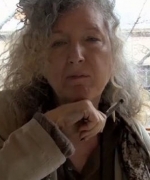
I'm stubborn. I was not--and I learned how to work with glass, and actually painting and drawing again just by doing it. I just really wanted to do it no matter what, so I just persisted. I think that is 9/10ths of it, it's not-- You know how they say something is 9/10ths perspiration and 1/10th inspiration? I think it's probably 1/10th perspiration, 1/10th inspiration, and 98% persistence. My accident has made me more creative in that it made me have to figure out if I'm here and want to get there, I can't just go that way. What can I do to get there? How can I get there? And that is--by that example I mean everything from physically getting from point A to point B, to drawing something, or communicating in a certain way with a specific audience. So it's made me more creative in that I have to figure out if I can't do it the way I used to, how can I do it?

show transcriptShow transcript | Print transcript

Since her brain injury, world-renowned artist Ginny Ruffner has had to discover different and more inventive ways to create her art.

Produced by Victoria Tilney McDonough, Ashley Gilleland, and Jared Schaubert, BrainLine.


Ginny Ruffner Ginny Ruffner is an internationally acclaimed artist who lives in Seattle, Washington. In 2012, Ruffner was featured in a feature-length documentary called Ginny Ruffner: a not so still life, which focused on her refusal to let a debilitating brain injury slow down her drive to create art, the film challenges viewers to see the world from a new and unexpected perspective.


The contents of Brainline (the “Web Site”), such as text, graphics, images, information obtained from the Web Site’s licensors and/or consultants, and other material contained on the Web Site (collectively, the “Content”) are for informational purposes only. The Content is not intended to be a substitute for medical, legal, or other professional advice, diagnosis, or treatment.

Specifically, with regards to medical issues, always seek the advice of your physician or other qualified health provider with any questions you may have regarding a medical condition. Never disregard professional medical advice or delay in seeking it because of something you have read on the Web Site. If you think you may have a medical emergency, call your doctor or 911 immediately. The Web Site does not recommend or endorse any specific tests, physicians, products, procedures, opinions, or other information that may be mentioned on the Web Site. Reliance on any information provided by the Web Site or by employees, volunteers or contractors or others associated with the Web Site and/or other visitors to the Web Site is solely at your own risk.

Related Content

Audio/Video:
 

 Comments [2]

After I had my life-saving brain injury, I was extremely hard put to make anything happen for myself; however, I utilized my affinity for creative writing: poetry, and, despite the fact that I was faring miserably in most of my classes, including Junior English, I continued to excel in creative writing. Following my having undergone one final operation to replace the malfunctioning ventricular shunt in my brain, I was able to flourish, once again, in my other content areas courses. Upon my graduation, I served as one of the school literary magazine's editors and, five years later, took a bachelor's degree in creative writing. Recently, I finished a Masters of Education degree in writing education: the thesis of which was an alternative poetry-intensive curriculum to facilitate learning-disabled individuals' acquisition of specific writing skills that rhetoric-intensive curricula do not facilitate. The definition I used to define poetry is: "the best words, in their best order."

Oct 3rd, 2012 1:05pm

After my head injury I was left with hand shaking and I could no longer sketch I am painting now and have found that in drawing water my hand shakes make it easier. I am not as detail oriented as before and now as long as the spirit of the image is there I am happy. trying not to sweat the small stuff. KLS

Sep 20th, 2012 9:37am


BrainLine Footer


BrainLine.org is a WETA website funded by the Defense and Veterans Brain Injury Center through a contract with the Henry M. Jackson Foundation. Government funding support is not an endorsement of WETA or any of its products, including this website.

© 2013 WETA All Rights Reserved