

A Traumatic Brain Injury Really Sucks
“Shut up and get me some f---ing’ water!” Those were my first words and the first thing I remember upon awakening. My sister was just droning on and on about stuff that I had absolutely no interest in, and I was tired and just wanted to sleep. So, me being me, just told her to shut up. I had no idea what my sister was doing near me in bed. Plus, I was thirsty and couldn’t get up for a drink. My other sisters, yes there were more than one, and my mom were there also, and they were all elated that I had spoken. That was my first clue that something was amiss, because normally I won’t shut up. A young adult woman then came in to the room; when told what I had said, she seemed genuinely happy. Shortly thereafter an adult male was told of my utterances and he seemed relieved. I thought, What the hell is going on? I couldn’t understand why everyone was so happy about what I had said. Speaking of everyone, who were all these people? What was my Mom doing here, and why didn’t she frown upon me for using the “f” word? What were all my sisters doing here?
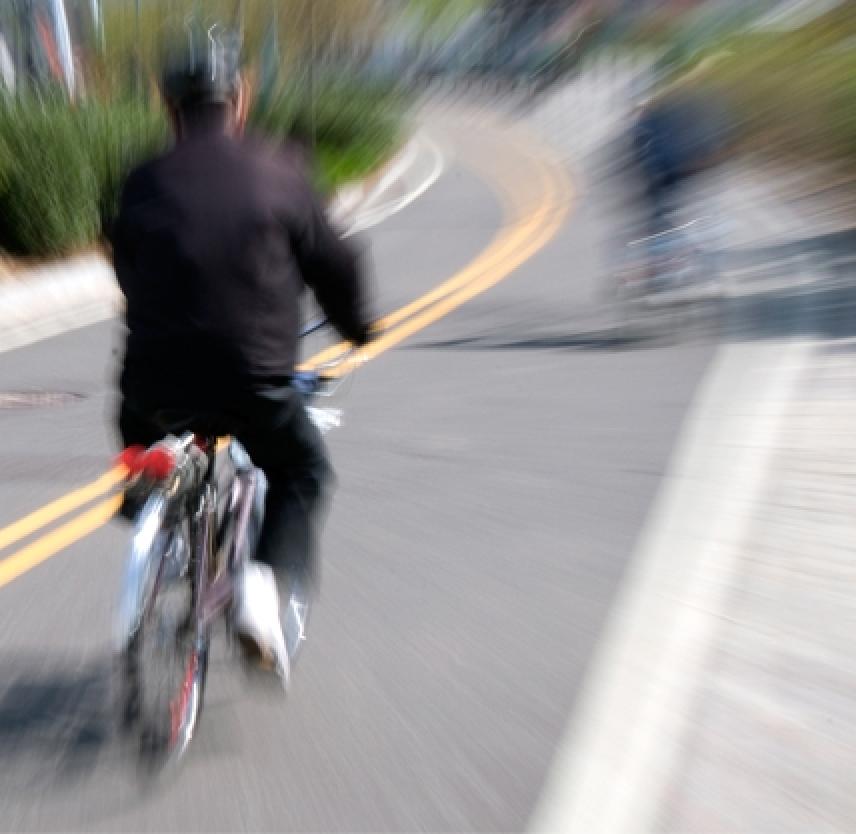
I don’t really know what happened next or how much time elapsed before it happened. I just remember lying in bed and hearing my brother-in-law tell me I was in a bike (bicycle) accident. I thought, Gee, must have been a doozy.” I didn’t quite get the gravity of the situation. I didn’t even realize where I was.
I must have crashed my mountain bike. I’m pretty good at doing silly stuff on that bike. I figured I had jumped off something or hit something and broken a few bones, it couldn’t be worse than that. Boy, was I wrong! The reason I thought that, was because I consider myself a competent and capable rider. I had been riding bikes since I was little kid. I rode my Western Flyer everywhere, all the time. As I grew older and more mature (no laughing) I replaced my beat-up ol’ Western Flyer with a twenty-four-speed mountain bike. Now I could ride faster, jump higher, and just generally do more testosterone-induced silly stuff.
I had recently discovered NORBA (National Off Road Bicycle Association) and racing mountain bikes. I loved it! Like everything else I enjoy, I dove into it full bore. I raced in NORBA as a beginner until I had won enough races to qualify to race for the Sport class (the next class after being a beginner). Having made it to this class in a relatively short period of time, I was getting cocky.
The season for mountain-bike racing is only a few months a year. I couldn’t get enough of going fast on my bike and I wanted to get a lot better at racing, so I decided to ride-year round. I lived in the Napa Valley where you needed to drive in order to get to some good biking trails. Putting my bike on the car, getting all my stuff together, driving to and from the trails, and wallowing in the mud got old after a while. I then decided I could at least stay in good physical riding shape if I rode my road bicycle, during the fall and winter. So I did...a lot.
I started doing criteriums (a short, fast, multiple-lap race around a short course) in Santa Rosa one night a week during the summer. In order to win criteriums, or crits, you need to ride fast. So, logically, I decided I needed to practice riding fast…all the time. Uphill, downhill, flatlands, mud, pavement, it didn’t matter to me; I just wanted to go fast. Maybe it’s just some male thing, I don’t really know.
One warm, beautiful day in the wine country (I lived in St. Helena, California) I decided to ride my road bicycle, a Bianchi, up to Angwin and back. My parents live in Angwin and I was raised there. Angwin is located at 1667 ft. on top of Howell Mountain, which helps form the eastern side of the Napa Valley. About halfway to the top, I looked ahead and saw what just about every unattached biker dreams of; some long, tan, smooth, well-toned legs, attached to a woman. Well, I managed to ride even faster! I caught up with her, and since she was not wearing a helmet, I had a good excuse to talk with her and tell her she should be wearing one.
It turned out that the girl’s father was my science teacher in junior high school. I rode with her all the way to her house, talking all the way, and talked with her some more once we got there.
In the right situations, I could talk for hours. Once, while in high school, two of my friends and I went skiing at Squaw Valley. The parking lot, highway, and everything else was totally packed, it was pretty slow going. It took us about three hours to get back to St. Helena. I told jokes the entire way home. As soon as I would start a joke, I would remember another, and so on. My two friends probably said only twenty words for the entire trip home. I don’t talk much anymore.
Anyway, I became friends with this girl, whose name was Cerise. At the time, I was twenty-five years old and I think she was only nineteen. I grew up with three older sisters and one twin sister, and one thing I learned is that one doesn’t come out and ask a woman her age. It’s a “no win” situation.
Cerise expressed an interest in bicycle riding and wanted to take it up. She didn’t want to race, just ride for enjoyment and exercise. That sounds oxymoronic but when it comes to bicycle riding, it isn’t. I, of course, was more than happy to help in any way possible. The first bit of advice I gave her was to get a bicycle helmet.
I had agreed to go on a ride with her after I got off work on September 15, 1995. I got off work around 4:00 P.M. I went home, changed into my biking clothes, jumped on my bike, and rode up to Cerise’s house. We went on a ride until just about dusk. The day was a Friday. Angwin is a Seventh Day Adventist Community and church is a very important to them. Their Sabbath is from sundown Friday to sundown Saturday. I am not an Adventist, but Cerise and her family are devout Adventists and recognizing the Sabbath is important to them. We returned from our ride that Friday and Cerise wanted to go to Vespers, (which is a Seventh Day Adventist meeting). She did, however, offer to give me a ride home, as the sun was sinking fast and it was becoming bicycle unfriendly.
Trying to be a stud and impress the girl, I declined and said I’d ride home. I should mention now, that for reasons the reader will discern later, I don’t remember any of this. I’m just guessing based on what I’ve been told and what I know of myself.
Off I went. I was tired from working all day and going for a bicycle ride. I had a girl and religion on my mind. Needless to say, I wasn’t thinking too clearly. I should also mention that the bicycle I was riding was a Bianchi, which is made in Italy for racing. It had no parts, and therefore no weight, that wasn’t absolutely necessary for racing. As a result, it was fast and didn’t have any lawsuit-induced safety equipment attached (i.e., reflectors). I didn’t have any sort of light either.
I was coming down from 1600 feet, hungry, horny, and tired. I was thinking of things besides riding a bicycle. I was going as fast as I possibly could, because I wanted to get home before it got totally dark.
On the way down there is a stop sign at the top of a very steep section of hill. It is only a three-way stop and all the roads are very visible. Chances are I didn’t even slow down, let alone stop, because I was in a hurry and no one was coming. I kept right on going and went down the steepest section of the hill. At the bottom there is a road, Crystal Springs, which adjoins the road I was on. Crystal Springs adjoins to my right as I went downhill.
As luck would have it, a person was driving up the road as I was going down. The driver turned left onto Crystal Springs. The speed limit on that hill is 35 MPH. It is estimated I was going between 40-50 MPH. It doesn’t take a vivid imagination to figure out what happened next.
The driver didn’t see me, obviously. It was 7:55 p.m and I didn’t have a bike light or reflectors. Now, everyone automatically assumes that is why I wasn’t seen. I, being the stubborn, macho guy that I am, have different ideas. The main problem for me is I don’t remember a thing. I know what I
think must have happened, based on the decisions I normally make when encountering a vehicle.
There are three items that I consider very important in explaining what took place and, of course, absolving myself of any guilt for what happened to me. Number 1: the driver of the car had a newborn infant with her. The driver, mother of the baby, most likely had a great deal of focus on the child, and not so much on the road. I don’t fault her at all for that; it’s probably a natural instinct that the mother in any and all species has. She probably heard the kid sneeze or something, just took a quick glance up the road, didn’t see anything or anyone, looked at the kid, and turned left. That brings me to number 2: the streetlight wasn’t working (I think). Had it been working, thus illuminating the area I was riding in, I might have been seen. Notice I used the word “might.” As I said before, I didn’t have any reflectors, which I should have. To make a long story short: she didn’t see me, I was breaking the speed limit, she turned left, and I hit her. Number 3: I believe the driver was not using her directional signal. I have absolutely no proof of this. I do know how I would ride when encountering a vehicle with its signal light on. First, I wouldn’t necessarily slow down, but I would proceed with caution. I would think of “escape routes” in case the vehicle did turn in front of me. I would position my body, hands, and arms so I could immediately hit the brakes if need be. I would consider a total plan of action to avoid colliding with the vehicle. As the car and I approached each other, I would look at the driver to see if I could discern his intention, hoping he had seen me and intended to turn after I went by. I would always think, Okay...If he turns now, I’ll do this...Okay...now I’ll do this. As the vehicle and I got close enough that I didn’t have an “escape route,” I would think, Okay…if he turns now, I’m f---ed!
If an oncoming vehicle did not have its directional on, I wouldn’t assume it was turning but intended to continue going straight. This is why I am fairly certain the driver did not signal before she turned. Again, I have no proof of this, and since I had just come from a ride with a girl I was interested in, there’s no telling what the hell I was thinking.
So here I am, twenty-five years old, just been riding bicycles with a babe, looking forward to the weekend, having a job I really enjoy, and basically just enjoying life.
It was 7:55 p.m., so there wasn’t much sunlight left. I, of course, was riding like a bat out of hell. A 1950 yellow pick up truck (with an infant that was only a week or two old) was coming up the hill. Again, I didn’t have any reflectors or even a bike light. The truck turned left onto Crystal Springs and I tried to break one of the basic laws of physics. The law that says two pieces of matter cannot occupy the same space at the same time, or something like that. Well, I certainly proved that law. I hit the truck, and ended up on the side of the road all bloody and unconscious. The driver of the truck, who’ll remain nameless, freaked out and started screaming. People at a nearby house heard her and called an ambulance. The collision happened only half of a mile from The St. Helena Hospital and Health Center (S.H.H.H.C). I was not taken there, however. I was routed to The Queen of the Valley Hospital in Napa, located 20-30 minutes away in the town of Napa. I was routed to Napa because The Queen has a much better equipped and staffed trauma unit.
Having survived this accident, I had amongst many other injuries, a TBI, or Traumatic Brain Injury. If you ask me, that is a pretty redundant name. What the hell would an Untraumatic Brain Injury be? I also had a broken neck. I fractured the C6, C7, and C8 vertebrae. Those are at the base of the neck. My right shoulder was also pretty much destroyed. There are a number of reasons why I didn’t die. I’ll share with the reader the main reasons that I believe I am still alive.
The first, and probably most important, is that I was wearing a bicycle helmet. The helmet is now split on one side, cracked in other places, and is shaved down on the right, front side. If my skull had received only a fraction of the damage my helmet did, I wouldn’t be alive, or I’d be a vegetable, at best. The second is my right shoulder. It bore the brunt of the collision with the truck. Had my shoulder not done so, I don’t believe the helmet could have saved me. The next reason is all the people in the medical field. The emergency medical technicians (EMTs), who were the first to treat me, kept me alive long enough to get to the hospital. Another reason is the woman who made the decision to route the ambulance to The Queen of the Valley hospital rather than S.H.H.H.C. because The Queen is much better prepared for head trauma. The final reason: I was in extremely good physical condition. I had very little fat on my body and my heart was in excellent shape, from all the riding I’d been doing. So riding my bicycle nearly got me killed but I believe it also helped save me.
Back to the helmet. As I said, the helmet was cracked, split, and shaved down on the right, front side. I don’t how it got that way. I can only speculate. I believe my helmet was shaved down because my head must have slid along the pavement after I collided with the truck. The helmet, sliding along the asphalt, created enough friction to tear through the plastic cover and then shave down the material that composes the helmet. I don’t even want to think what might have happened to my head had I not being wearing a helmet. It doesn’t take a genius to figure out I would not be alive today. I can’t stress
enough the importance of wearing a helmet.
Now, I must admit, I never wore a helmet as a kid riding my Western Flyer around the yard. I very rarely rode on pavement as a kid, and trees don’t turn left in front of you. As a youngster I, nor anyone else, was very aware of head trauma. I also never wore one during the five years I spent at the University of California, Davis (UCD). I probably should have, but UCD and the town of Davis, California, are set up for bicyclists, and the people in the town are very accustomed to us riding all over. So they are used to looking for and seeing cyclists. This results in relatively safe riding conditions. In retrospect, I probably should have been wearing a helmet during my time at UCD because the bicycle rider rides on the same streets with cars, buses, big trucks, etc. Hindsight is 20/20 and I came through fine, so I don’t think about it too often. Back to hitting the truck.
An ambulance picked me up and drove to Queen of the Valley Hospital. Incidentally, I learned after being released from the hospital that one of the EMT’s knew me but I was so covered in blood he didn’t recognize me until later.
Apparently, I hit the truck and flew over it. Unfortunately, my upper thigh caught on some part of the truck and, as I flew over, a big gash was ripped in it. I think that must be where most of the blood came from. I came to rest on the on the upward-sloped bank on the opposite side of the road. People in a nearby house were having a barbecue or something, and heard the woman who had been driving the truck screaming or crying. Someone there was the person who called for an ambulance.
Excerpted from TBI Hell: A Traumatic Brain Injury Really Sucks by Geo Gosling. © 2006, Geo Gosling. Used with permission. For more information on TBI Hell, go to www.amazon.com.
Comments (1)
Please remember, we are not able to give medical or legal advice. If you have medical concerns, please consult your doctor. All posted comments are the views and opinions of the poster only.
jeff sakacsi replied on Permalink
Very good to read for the first time as I just found it online. I too was riding my bike and hit extremely badly by folks not following driving rules and came out with a TBI and other injuries! I am desperately hoping to be better and well again and am glad to find another one write about a similar terrible incident. Thank you very much!