
On the walls of Anne Moessner’s office are Christmas and graduation cards. There are wedding and birth announcements and photographs sent from former patients and their families. These cards and photos make up a collage of lives — and Anne has stories about each of them. “In my experience, people with brain injury often exceed their early prognoses and expectations,” says Anne, a traumatic brain injury (TBI) clinical nurse specialist at Mayo Clinic. “People’s drive and resilience, as well as that of their families, never cease to amaze me.”
Embrace the chaos
Anne, who has been at Mayo for 24 years, coordinates the care of kids and adults with brain injury from the minute they arrive at Mayo Clinic until … forever. In essence, she is a sort of medically-trained case manager. “I am a person they can always call, even years later,” she says. A boy she took care of more than twenty years ago — now a man with a regular job and a good life, according to him — phoned her recently. His mother had died and he needed some support. He turned back to Anne for resources. “I remain a primary contact while they’re here, after they’re gone … and always,” she says. “Mayo is big … there are more than 30,000 staff members at the Rochester [Minnesota] campus alone. Who doesn’t want a medical contact who will always call back … especially for people with TBI who may be living with life-long issues?”
Anne didn’t set out thinking she’d devote her life to working with people with brain injury. In 1986, newly sprung from nursing school, she thought she wanted action — acute care with all the life-saving machines and code reds, the sprint of feet next to gurneys lifted from ambulance beds, the whoosh-whoosh of helicopters landing on the hospital roof. Instead she was assigned to the rehabilitation floor. She soon found that working with people with brain injury was the perfect fit for her personality. “Staff who gravitate toward working with people with TBI tend to think on their feet, go with the flow, and have a sense of humor,” she says. “We don’t necessarily like calm and predictable; we tend to embrace chaos.”
Celebrating the big — and small — steps
It can be a bit overwhelming at times to be the lone medical person in a waiting room with a distressed family … 20 family members and friends waiting to hear what’s happened to their hurt teenager. “I sit with the families. I prepare them for what happens during each stage of recovery, and I try to answer whatever questions they have,” says Anne.
Anne has learned that early intervention is crucial for people with TBI, from acute care through all phases of rehabilitation. “The minute the neurosurgeons think a patient can have any rehab, we’re in there … usually within 1-2 days of the patient’s arrival at Mayo,” she says. Physical therapists will work on range of motion and mobilization, which helps stave off lung and circulation problems. Occupational therapists will help the patient with swallowing and, when ready, fine motor skills and cognitive rehabilitation. Speech therapists will also come early on, when the patient starts to wake up. Anne works closely with this rehab team. “Although the earlier the intervention the better, people with TBI can almost always make some gains with the help of rehabilitation,” she says.
At Mayo, staff can see as many as 1,000 people with TBI a year injured by falls, car crashes, or sports concussions. Three quarters of those have milder injuries, the last quarter severe. “Fortunately, I have only a few patients a year who end up totally dependent, living in a nursing home or group home,” she says. “It’s really not that common of an outcome when you look at the numbers. We have learned a lot about how to improve outcomes, and most people do get better and live in the community.”
Anne says it upsets her when she hears staff members saying to families, Your son will never walk again …or speak again … “What’s the point of stripping people of hope, especially early on, when no one knows for certain how things will turn out? I don’t have a crystal ball. No one does. Why say if when saying when is so much more powerful? After all, we have seen time and time again patients exceeding the limitations put on them,” says Anne. “Families invariably remember the nay-saying staff, the ones who said Your daughter will never … or Put her in a nursing home. When that kid is better and walking and talking and holding down a job, I encourage them to visit the acute care staff so they can see that many patients make solid recoveries, that what they do early on makes a huge difference, that it’s okay to be hopeful.” Anne laughs and adds, “I mean, you never hear from a family, Damn you for being too hopeful!”
Anne emphasizes that it’s crucial to celebrate with the families every step of the way. Recovery can be a very long, arduous process. If a mother excitedly tells a nurse, I think I saw his eyes flutter … I think he squeezed my hand … I think he’s coming out of the coma … the nurse or doctor should say, People usually respond to their loved ones first so that makes sense. I can’t wait to see that, too! Why say I didn’t see that so I can’t document it or That was probably just a reflex? Encouragement and support from professionals as well as from family and friends play an enormous role in a patient’s recovery.
Reaching beyond the walls of Mayo
When Anne is not working with patients, she is reaching out to the community and learning more about the system of care that extends beyond the walls of Mayo Clinic. “The longer I am in this field, the more I realize that system change is what is going to make the biggest difference to people living with long-term residuals from TBI,” she says. Anne sits on several committees that look at state-wide issues in Minnesota, Iowa, and Wisconsin. “Outreach is another way for me to hook up with other passionate people and brainstorm ways to help those with TBI in the short- and long-term. Learning what others are doing that works keeps me fired up. Every time I go out into the community, I think … how can I expand what I know and do?”
One committee in particular, the “TBI Family Caregiver Panel,” has been a real education for this seasoned TBI nurse. The National Defense Authorization Act of 2007 mandated the establishment of a 15-member panel to develop a uniform and consistent curriculum to educate family members caring for members of the Armed Forces with severe TBI. Managed by the Defense and Veterans Brain Injury Center, the panel includes medical professionals who specialize in TBI, staff from the Department of Defense and Veterans Affairs and other agencies, family caregivers, and members of the Armed Forces who had a brain injury.
Anne and the other members of the panel have created a four-module curriculum that will include a binder of information, a set of DVDs, and information available from The Center for Excellence for Medical Multimedia. The curriculum covers the basics about TBI, understanding the effects and how to help, becoming a family caregiver, and navigating the system. It’s slated to roll out at the end of 2009. “This has been an incredible project for me since in my career I’ve mostly worked with kids and families,” says Anne. “Focusing on military service members and their families has given me new layers of perspective on caregiving for people with brain injury.”
Finding answers
The biggest challenges in care that Anne has witnessed in the last 10-15 years are the trickle-down effects from changes in medical insurance. People used to stay for inpatient rehab after a TBI for several months; now it’s two to three weeks. “Everything is compressed now. Not only do we have more to do in a lot less time, but the families have to take on much more responsibility sooner,” says Anne. “We’ve had to beef up our outpatient clinics and our family education because patients are home with their families a whole lot sooner than they used to be. Outpatient therapy tends to last a lot longer than inpatient. We try to refer everyone to their state Brain Injury Association, a wonderful community resource”
Collaborating with local networks and organizations has helped her offer more viable long-term solutions to patients and their caregivers, she says. And since she gets to know the families she works with so well, she’ll often link them with other families who can serve as mentors. “Putting families together helps on so many fronts,” says Anne. “The peer mentoring family can guide the new family by providing ideas and resources that worked for them, and, most importantly, they can offer support and empathy since they have traveled a similar path.”
For the past decade, Mayo Clinic has been part of the TBI Model Systems, a federally-funded network of centers that conduct research and provide state-of-the-art services for people with TBI. As part of the TBI Model Systems data center, Mayo tracks people with traumatic brain injury to look at long-term outcome. “It’s been gratifying to learn that the majority of people living with TBI report that they’ve got a few problems, but overall life is good. Maybe it’s not exactly the life they’d pictured, but it’s still good,” says Anne.
Caring and knowing
Recovery from brain injury is often described as a marathon, not a sprint. “I always ask families if they have a website like CaringBridge set up for their loved one, and then I ask if I can follow along,” says Anne. Web services like CaringBridge help people stay connected with family and friends during a health crisis. “Invariably, families say yes. I have found this helpful on many levels. I can learn about the patient — what he was like before his TBI … his interests, his friends, what he looked like. I can also learn about the family, its dynamics, and, on a regular basis, I can also gauge stress levels, which can help me be more effective.”
On their personalized website, families can post updates and photos and keep a blog or journal. With a shared code, friends and extended family can log on to check their loved one’s progress and post their own comments and prayers. Having one place to say what’s happening saves the caregiver from having to place countless telephone calls. And writing about a loved one’s progress or lack thereof can often prove less stressful than having to talk about it.
In addition to learning more about her patients and their families, following along on family websites has also helped Anne clear up misunderstandings. She remembers being present when a neurologist gave a family a certain message about their loved one. She thought what he said had been clear. But when she logged onto the family’s CaringBridge site, she learned that the family had heard something quite different. Because she learned about the misunderstanding, she was able to clear it up before it became a problem.
Stories on the wall
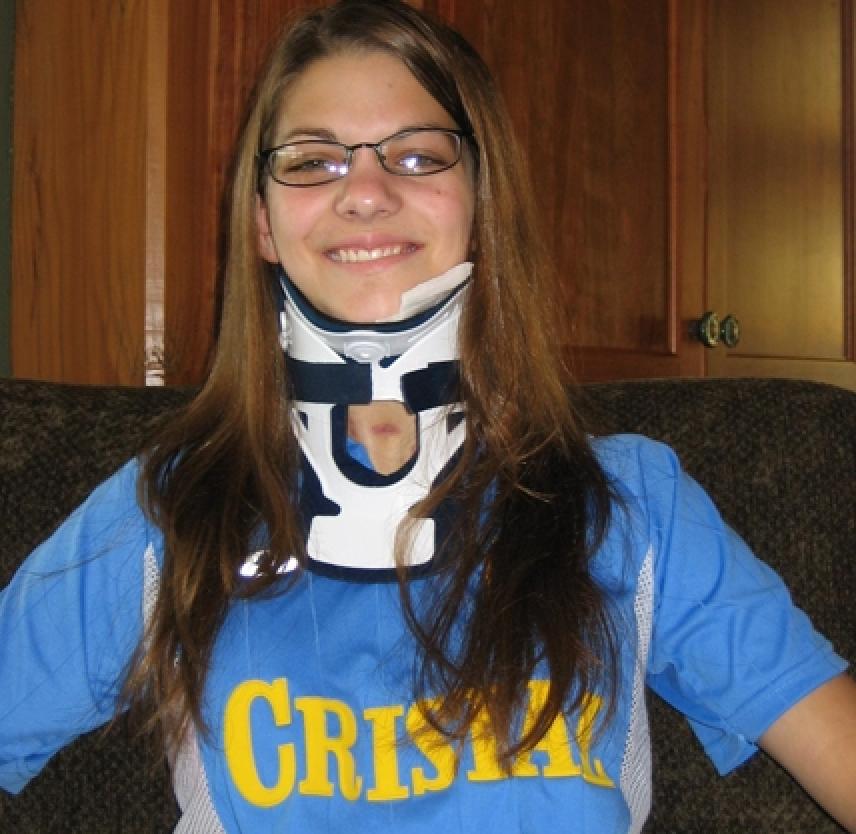
Amidst the cards and photographs on Anne Moessner’s office walls, you’ll find a few of a feisty and glowing young girl named Freda.
Three years after Freda sustained a severe brain injury in a motorcycle crash, her mother stopped by to see Anne, the ebullient nurse at Mayo Clinic who had managed Freda’s care. “Today is the three-year anniversary of Freda’s accident, and I needed to be with someone who understood … someone who has seen what’s happened since that day,” said the mother. The two women hugged. No words were needed to share their joy over Freda’s miraculous recovery. The young girl was about to begin her freshman year at Purdue University.
Such are the stories that make Anne Moessner tick.
See "Flat Freda" Slideshow
To comment or to share your story, contact Victoria Tilney McDonough at vmcdonough@weta.com.
BrainLine
Comments (3)
Please remember, we are not able to give medical or legal advice. If you have medical concerns, please consult your doctor. All posted comments are the views and opinions of the poster only.
Anonymous replied on Permalink
Anonymous replied on Permalink
Anonymous replied on Permalink