

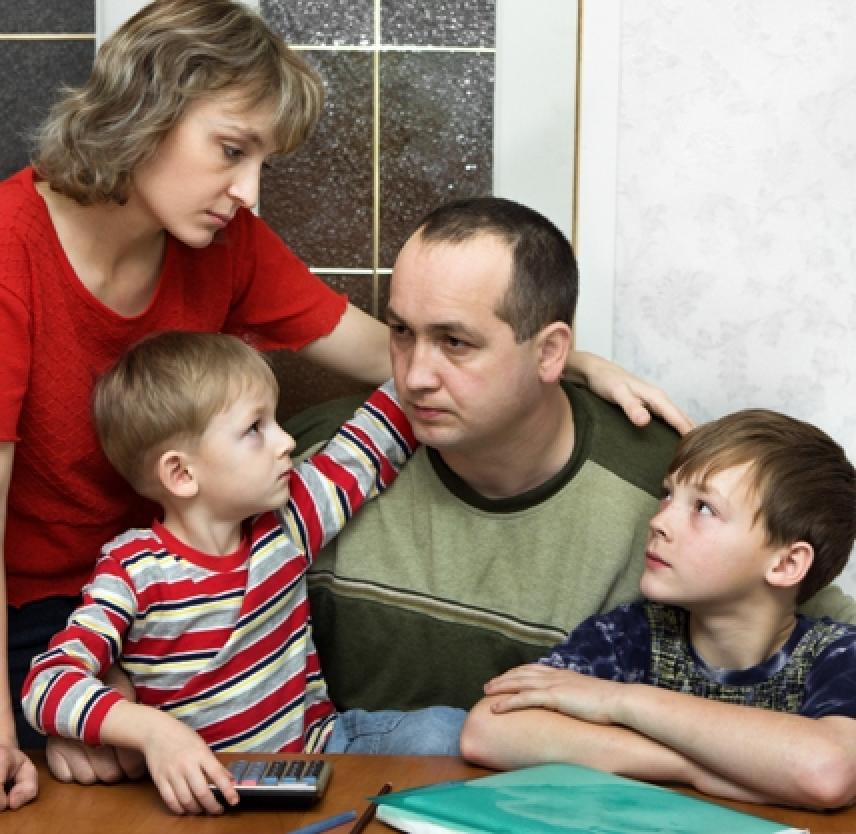
Family life often changes dramatically after brain injury. Changes may persist for months or years. Look at the quotes from family members that follow this paragraph. Perhaps you’ve heard your family members make the same comments. Perhaps you’ve said these things to yourself.
“Everything has changed since my son’s injury. I haven’t had a minute for myself.”
“I’ve missed my last two doctor’s appointments because no one else could get him to his physical therapy appointments.”
“I am exhausted. We can’t count on anything anymore. Nothing has been the same since the accident.”
After TBI, the sole focus of rehabilitation staff and family members is on the needs of the person with the injury. Because there is such a great focus on the patient, family members often lose sight of their own well-being and how their lives have changed.
Research shows that family members who serve as caregivers commonly face many difficulties after injury. On an emotional level, feeling overwhelmed and frustrated is a common experience. Many caregivers are upset by their loved one’s suffering, loss of abilities, and need for complex medical care. Aside from financial concerns, many people worry about their ability to provide quality care and whether family life will ever return to “normal.” Feeling worn out by the increasing number of responsibilities they have taken on is a common experience.
There is no doubt that family members have an important role in rehabilitation and recovery. As a family caregiver, you may be wondering how you can stay healthy and emotionally strong in the face of so many challenges.
Recognizing how your life and the lives of other family members have been changed by injury is an important first step in recovering emotionally. We have developed the Family Change Questionnaire (FCQ), a tool to help people recognize and think about the changes. The FCQ has 17 questions relating to topics such as feelings at the time of injury, fears about long-term injury effects, and the emotional reactions of other family members. The FCQ also asks people to think about changes in their responsibilities, roles, transportation needs, finances, and plans for the future.
The FCQ, presented below, can be used in several different ways. We encourage you and your family to fill in the questionnaire and discuss your answers. Usually, the questionnaire can be completed in 20 minutes or less. If you are in counseling, your counselor can use the questionnaire as a tool for individual, group, and family sessions.
- How did you feel when you first learned that your injured family member was injured?
- How did you feel when you realized that your injured family member was going to live?
- How did you feel when you began to recognize that the brain injury might have long-term effects?
- How have other family members reacted to your injured family member’s injury?
- Have you made yourself available to provide more emotional support to your injured family member and other family members? If yes, how so?
- Before the brain injury, what were the most important plans you had for your future and your family’s future?
- How has the brain injury affected your plans for the future?
- What responsibilities do you now have to care for your injured family member?
- In what ways do you help your injured family member get back and forth to appointments?
- Do you attend therapy and doctors’ visits with your injured family member? Please explain.
- Do you help your injured family member with filling out insurance, registration, medical, and disability forms? Please explain.
- Do you help your injured family member get authorizations for medical and rehabilitative care? Please explain.
- Have you taken over responsibilities from your injured family member or uninjured family members? If yes, what new responsibilities do you have related to caring for the house, maintaining the car(s), working, paying bills, and caring for children?
- Have you changed your work responsibilities or hours since the injury, so that you could help your injured family member or the family? Please explain.
- How has your family’s income been affected by the injury?
- What new expenses are you facing because of the injury?
- How have your sports, social, and recreational activities changed because of the injury?
In our experience, the FCQ has been a useful tool, helping people understand how the lives of more than one family member has been affected. Discussing your answers to the questions will help improve understanding and communication. Regular family discussions about feelings and ideas can undoubtedly strengthen the family support system and help people successfully overcome challenges on the road to recovery.
From the National Resource Center for Traumatic Brain Injury, Virginia Commonwealth Model Systems of Care. Reprinted with permission. https://tbi.vcu.edu/.
Comments (9)
Please remember, we are not able to give medical or legal advice. If you have medical concerns, please consult your doctor. All posted comments are the views and opinions of the poster only.
Anonymous replied on Permalink
Amazing and so understandable article, well written. We understand first hand and have a created an all volunteer recreation 501c3 in NY.
THE SOCIAL BRAIN. where survivors and families come together all are welcome
www.thesocialbrain.org
Facebook The Social Brain
Sue replied on Permalink
Anonymous replied on Permalink
43 years of living with brain issues for a son following meningitis/shunting for hydrocephalus (16 surgeries in the first 18 years), seizure issues, etc. Then husband contracted encephalitis 26 years ago and had a total change of personality. Then 4 yrs. ago he had a cardiac arrest and now we are dealing with even more issues. Were it not for my very strong Catholic Faith and the belief that all human lives matter and that we are to "offer up" our trials ............ It's difficult to do much of anything; family members don't come to the forefront because they are living their own lives, etc. It's just life---and each person/family must simply learn to live it as it comes moment by moment. Can't pre-think about things, can't plan much ahead. But God's grace is always given in the moment.
Anonymous replied on Permalink
It's because of the personality changes in the injured. Such as emotional disregulation and paranoia. It is hard for them to understand that it is the injury's faults and not the person just being difficult.
Anonymous replied on Permalink
It's been 9 years since my TBI/PTSD and my family does not even pretend to like me. I am aware that a brain injury causes friends and family to disappear but would like to know why this is common. Lonely
Deborah replied on Permalink
I am sorry to hear that, some of our family treat my son poorly as well. I wish you the very best. And you aren't alone. Much love....
Anonymous replied on Permalink
I have an unusual family issue. My husband suffered a brain injury before we met. For 20 years I was his caregiver/assistant in life. His brain injury went undiagnosed so we didn't know what we were working with. We simply learned to work around his challenges. Several years later, our young daughter suffered an acquired brain injury secondary to mental illness. We weren't told about the ABI. It was through my own research and discussion with her Psychiatrist that we realized we were actually battling two completely different illnesses. I learned to do what was necessary to care for her as well as my husband, who by then had slipped into a clinical depression. Almost ten years ago I suffered an ABI secondary to post surgical bacterial meningitis followed by a MTBI from an ATV accident. I had been the caregiver throughout the years. Now however, I have become the patient. How does my brain injured family learn to cope and care for me now that I can no longer care for them or myself? The only "normal" family member, our son, has not been home for nearly seven years. He won't talk about it with us but I believe he is unable to deal with us as his family. Where are the studies about families like mine? I know we can't be the only family going through this.
Tina replied on Permalink
No your not the only family going through this. I'm only a caregiver to one person with TBI. My husband much like yours suffered an accident before we got together and was never properly taken care of for his TBI. This was close to 30 years ago. For about the last 10-13 years his moods and attitude has changed drastically. I've thought of getting a separation because our 16 year old daughter and I can't handle the way he is. He has no motivation to do anything and it seems like he's mentally deteriorating. He's almost 50 and acts like a 10-13 year old. We've been together for 25 years and married for 18. I can't seem to find help anywhere. He was diagnosed with bipolar but I'm nows questioning that diagnosis. I've doing research and yes he's clinically depressed but I don't believe its bipolar. I really believe its TBI with Chronic PTSD.
His accident was an auto accident. His buddies were drunk and high driving like 90 on a back road and crashed. They were in a bronco and he hit the back of his head on the row bar in the back. He suffers from seizures 2 types. JIMMY and GRAN MAL. He's was sent home from the hospital within a couple hours after arrival and was told he was fine. The next morning he woke up and started seizing. If he gets hit in the back of the head hard he will die.
Thanks,
Tina
Anonymous replied on Permalink
Thanks for this info which is def useful if things are worse. I have mild concussion & hope will improve. It is day 1/2 after an accident. Not feeling great at all & goes up & down.